HuagongsheHuagongshe Chemistry Print Report · For research reference only
HRID 1189600Generated: October 26, 2026
1-Bromo-2-naphthol → HCID 50992704, compound
https://huagongshe.com/reaction/1189600
Participants
| Role | Name | HCID | Charge |
|---|
| Reactant | 1-Bromo-2-naphthol | HCID 11316 | — |
| Reactant | Potassium Carbonate | HCID 11430 | — |
| Reactant | Tri-o-tolylphosphine | HCID 80271 | — |
| Reactant | 2-Fluorophenylboronic acid | HCID 2734354 | — |
| Catalyst | palladium(II) acetate | HCID 167845 | — |
| Solvent | Ethanol | HCID 702 | — |
| Solvent | Toluene | HCID 1140 | — |
| Product | HCID 50992704 | HCID 50992704 | 69% |
Reaction Steps
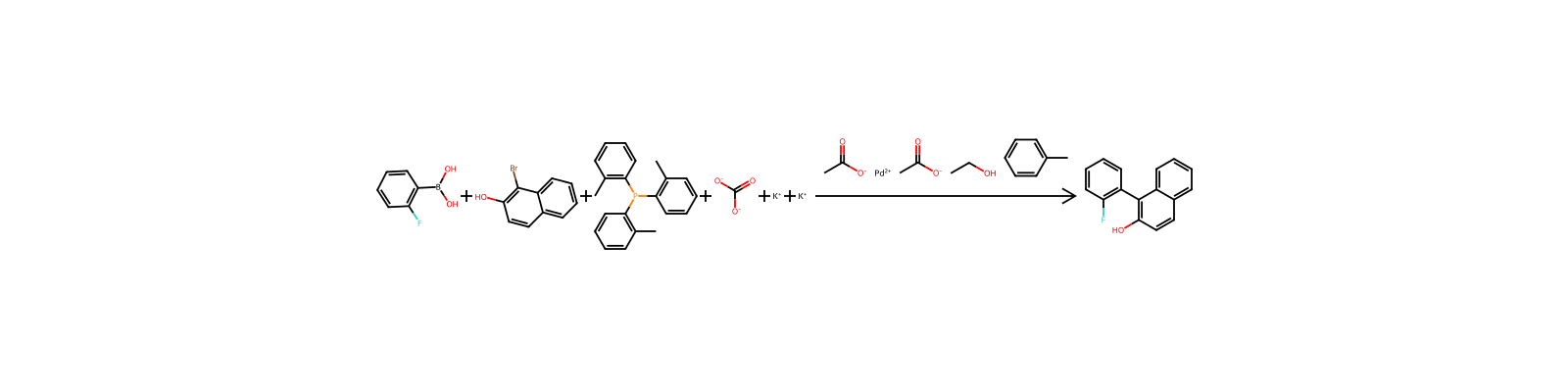
Into a 200 mL three-neck flask were placed 1.4 g (10 mmol) of 2-fluorobenzeneboronic acid, 2.2 g (10 mmol) of 1-bromo-2-naphthol, 153 mg (0.5 mmol) of tri(o-tolyl)phosphine, 25 mL of toluene, 25 mL of ethanol, and 5.0 mL of a 2M aqueous solution of potassium carbonate. This mixture was degassed under reduced pressure, and the air in the system was replaced with nitrogen. This mixture was stirred at 80° C., 23 mg (0.1 mmol) of palladium(II) acetate was added thereto, and the mixture was refluxed at about 100° C. for 6.5 hours. After the reflux, this mixture was washed with water, and the aqueous layer was subjected to extraction with ethyl acetate. The obtained solution of the extract and the organic layer were combined and washed with saturated brine. The obtained organic layer was dried with magnesium sulfate. This mixture was gravity-filtered, and the obtained filtrate was concentrated to give a brown oily substance. This oily substance was purified by silica gel column chromatography (developing solvent: toluene), so that 1.6 g of a brown oily substance of the object of the synthesis was obtained in 69% yield. The reaction scheme of Step 1 is illustrated in (E1-1).
Provenance & Evidence
| DOI | 10.6084/m9.figshare.5104873.v1 |
|---|
| Patent number | US08674117B2 |
|---|
| Source dataset | uspto-grants-2014_03 |
|---|
| ORD ID | ord-a68a8049c63445bcacc3529f009e74f0 |
|---|
| Source note | uspto-grants-2014_03 |
|---|