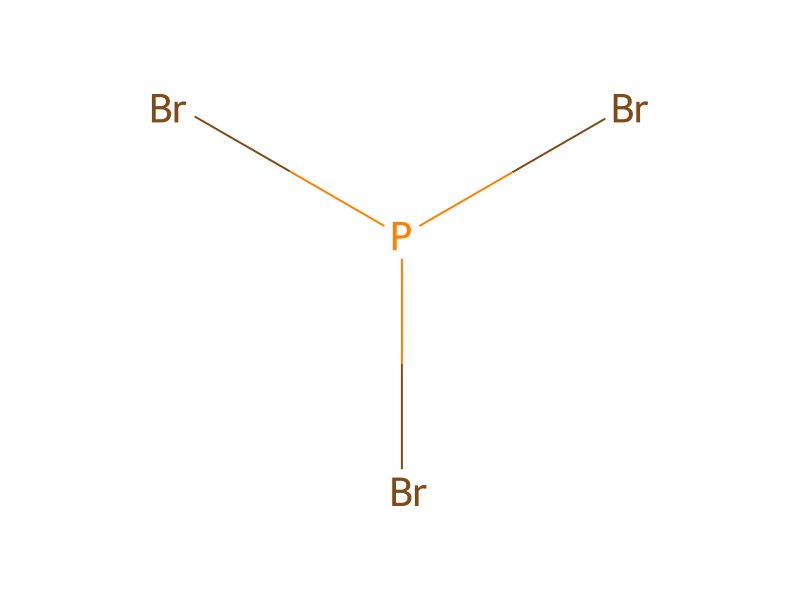
Phosphorus tribromide → HCID 60207313, compound
Reaction equation

[Cl:1][C:2]1[CH:7]=[C:6]([Cl:8])[CH:5]=[CH:4][C:3]=1[S:9][C:10]1[S:14][C:13]([CH:15](O)[CH3:16])=[CH:12][C:11]=1[N+:18]([O-:20])=[O:19].[Br:21]P(Br)Br>ClCCl>[Br:21][CH:15]([C:13]1[S:14][C:10]([S:9][C:3]2[CH:4]=[CH:5][C:6]([Cl:8])=[CH:7][C:2]=2[Cl:1])=[C:11]([N+:18]([O-:20])=[O:19])[CH:12]=1)[CH3:16]Participants
4
Reactant 2

Product 1

Reagents, catalysts & solvents 1

Procedure
To a solution of 1-[5-(2,4-dichlorophenyl)sulfanyl-4-nitro-2-thienyl]ethanol from example 26 (0.6 g, 1.7 mmol) in dichloromethane (10 mL), was added tribromophosphane (0.28 mL, 2.55 mmol). The resulting reaction mixture was kept under reflux for 2 hours. After this time, the reaction mixture was cooled to ambient temperature, quenched with sat'd sodium carbonate aqueous solution and extracted with ethyl acetate. The combined organic phase was dried (Na2SO4) and concentrated to afford the title compound (800 mg). The crude product was used as such for the next step.
Workup
- customThe resulting reaction mixture
- temperatureunder reflux for 2 hours
- customquenched with sat'd sodium carbonate aqueous solution
- extractionextracted with ethyl acetate
- dry with materialThe combined organic phase was dried (Na2SO4)
- concentrationconcentrated
Sources & evidence
- ORD record
- ord-2ff27a32ac74454abc490c7171903f2f
- Source dataset
- uspto-grants-2014_03
- Patent number
- US08680139B2
Reaction notes
Loading…