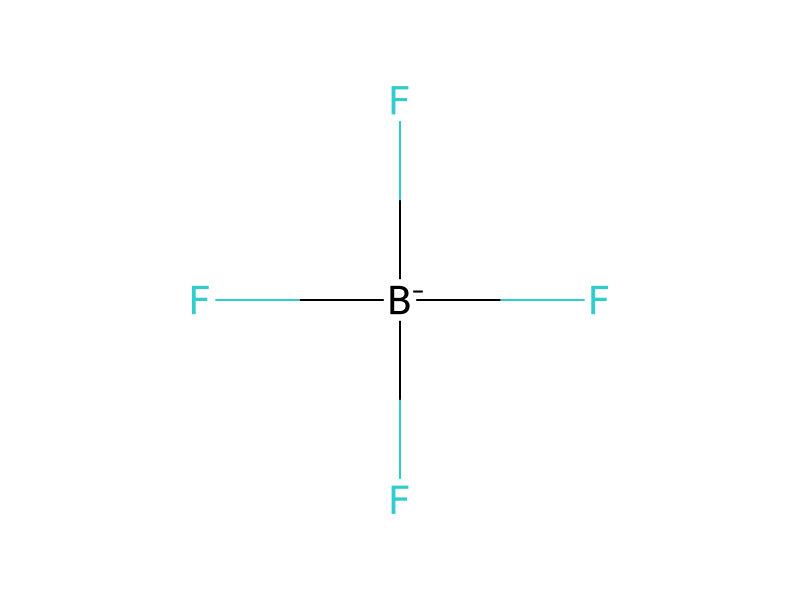
Tetrafluoroborate → Ethyl-4,4-difluorocyclohexane carboxylate
Reaction equation

F[B-](F)(F)F.[FH:6].[FH:7].F.C(N(CC)CC)C.[C:16]([CH:21]1[CH2:26][CH2:25][C:24](=O)[CH2:23][CH2:22]1)([O:18][CH2:19][CH3:20])=[O:17]>>[C:16]([CH:21]1[CH2:26][CH2:25][C:24]([F:7])([F:6])[CH2:23][CH2:22]1)([O:18][CH2:19][CH3:20])=[O:17]Participants


Procedure
Procedure for the fluorination of carbonyls in various solvents (examples 68-69): To a mixture of the diethylaminodifluorosulfinium tetrafluoroborate (458 mg, 2.0 mmol) and triethylamine trihydrofluoride (163 μL, 1.0 mmol) in the solvent (2.0 mL), at room temperature and under nitrogen, is added 4-carboethoxycyclohexanone (159 μl, 1.0 mmol). The reaction mixture is stirred for 23 h, then quenched with a 5% aqueous sodium bicarbonate solution, stirred for 15 min, and the resulting mixture was extracted using pentane. The organic phases were combined, dried over magnesium sulfate and filtered through a pad of silica gel. Solvents were evaporated to provide 4-carbethoxy-1,1-difluorocyclohexane admixed with 4-carbethoxy-1-fluorocyclohex-1-ene as a clear oil (refer to the following table for yields and product distribution).
Workup
- customquenched with a 5% aqueous sodium bicarbonate solution
- stirringstirred for 15 min
- extractionthe resulting mixture was extracted
- dry with materialdried over magnesium sulfate
- filtrationfiltered through a pad of silica gel
- customSolvents were evaporated
Sources & evidence
- ORD record
- ord-1054237749ef4cd6aa72d8934bf7b276
- Source dataset
- uspto-grants-2014_03
- Patent number
- US08680332B2
Reaction notes
Loading…