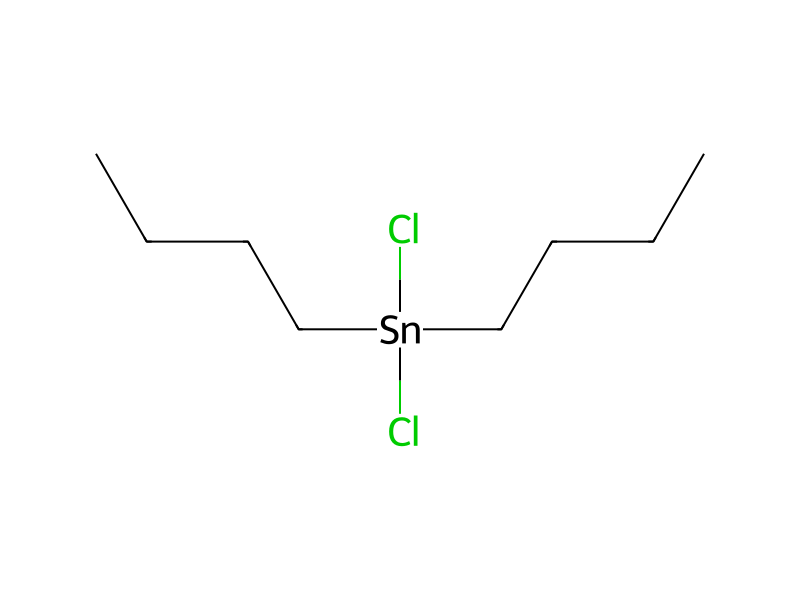
Dibutyltin dichloride → Dibutyl(difluoro)stannane
Reaction equation

[CH2:1]([Sn:5](Cl)(Cl)[CH2:6][CH2:7][CH2:8][CH3:9])[CH2:2][CH2:3][CH3:4].[F-:12].[F-:13].[NH4+].[NH4+]>>[CH2:1]([Sn:5]([F:13])([F:12])[CH2:6][CH2:7][CH2:8][CH3:9])[CH2:2][CH2:3][CH3:4]Participants


Procedure
Advantageously, dibutyl tin chloride and an ammonium difluoride are reacted to form a dibutyl tin difluoride precipitate. Dibutyl tin dichloride (DBTCl) is solubilized in an alcohol, preferably methanol, in a first reaction vessel. In a second such vessel, ammonium difluoride (NH4F, HF) is dissolved in a solvent which is preferably water. The contents of one reaction vessel are poured into the other and, on contact of the two solutions, a dibutyl tin difluoride precipitate is formed. The mixture is stirred to enhance the contact between the two solutions and to maximize the yield of precipitate. The resulting precipitate is recovered, drained, washed with water, washed with a solvent such as acetone to eliminate any remaining water and dried.
Sources & evidence
- ORD record
- ord-f36e1df4980c4bd48ee65cce9185e682
- Source dataset
- uspto-grants-1989_03
- Patent number
- US04812332
Reaction notes
Loading…