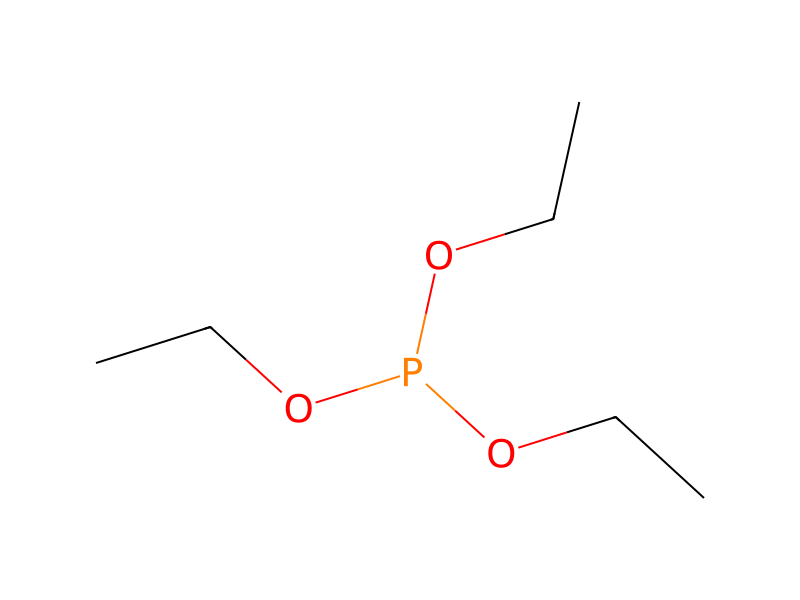
Triethyl phosphite → Diethyl [(2-phenyl-1,3-oxazol-5-yl)methyl]phosphonate
Reaction equation

Cl[CH2:2][C:3]1[O:7][C:6]([C:8]2[CH:13]=[CH:12][CH:11]=[CH:10][CH:9]=2)=[N:5][CH:4]=1.[CH2:14]([O:16][P:17]([O:21]CC)[O:18][CH2:19][CH3:20])[CH3:15]>>[CH2:14]([O:16][P:17]([CH2:2][C:3]1[O:7][C:6]([C:8]2[CH:13]=[CH:12][CH:11]=[CH:10][CH:9]=2)=[N:5][CH:4]=1)([O:18][CH2:19][CH3:20])=[O:21])[CH3:15]Participants
3


Procedure
5-Chloromethyl-2-phenyl oxazole (870 mgs, 4.50 mmol) and triethylphosphite (1.17 ml, 6.75 mmol) were heated at reflux for 3 h, cooled, the excess triethylphosphite removed under reduced pressure and the residue column chormatographed (0 to 5% MeOH/CH2Cl2, 10 g silica) to give the title compound (794 mgs, 2.69 mmol, 60%); δH (CDCl3) 1.30 (6H, t, J 7 Hz, OCH2CH3), 3.30 (2H, d, JP-H 22 Hz, CH2 --P) 4.10 (4H, m, OCHH2CH3), 7.00 (1H, d, JP-H 3 Hz, CH-4), 7.40 (3H, m, Ph), 8.00 (2H, m, Ph).
Workup
- temperatureat reflux for 3 h
- temperaturecooled
- customthe excess triethylphosphite removed under reduced pressure
Sources & evidence
- ORD record
- ord-10f591fc1b4844609c7300c68b89c6ee
- Source dataset
- uspto-grants-1989_03
- Patent number
- US04812470
Reaction notes
Loading…