4-(Dimethylamino)-cinnamaldehyde → Photobiotin
반응식

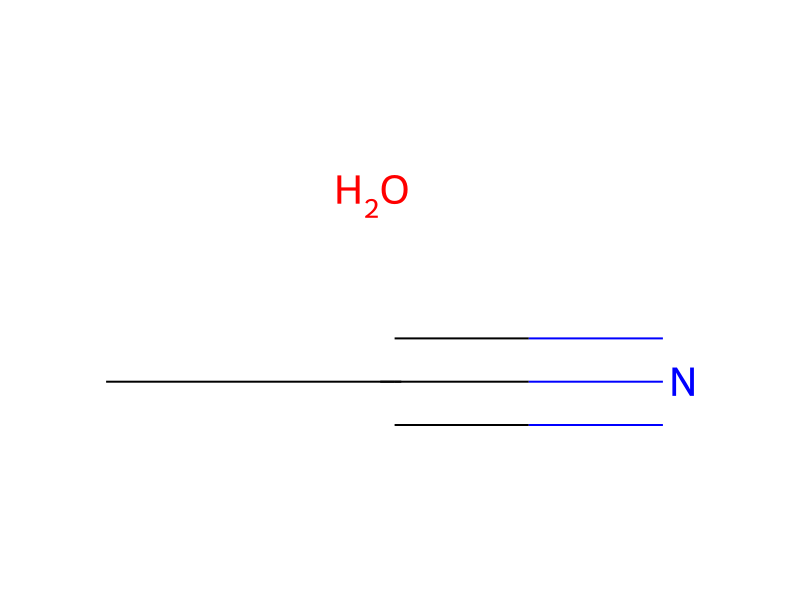
C(#N)C.O.CN(C)C1C=CC(C=CC=O)=CC=1.OC(CCCC[C@H]1[C@@H]2[C@@H](NC(N2)=O)CS1)=O.[CH3:34][N:35]([CH2:52][CH2:53][CH2:54][NH:55][C:56]([CH2:58][CH2:59][CH2:60][CH2:61][CH:62]1[S:66][CH2:65][C@@H:64]2[NH:67][C:68]([NH:70][C@H:63]12)=[O:69])=[O:57])[CH2:36][CH2:37][CH2:38][NH:39][C:40]1[CH:45]=[CH:44][C:43]([N:46]=[N+:47]=[N-:48])=[CH:42][C:41]=1[N+:49]([O-:51])=[O:50]>O>[N:46]([C:43]1[CH:44]=[CH:45][C:40]([NH:39][CH2:38][CH2:37][CH2:36][N:35]([CH2:52][CH2:53][CH2:54][NH:55][C:56](=[O:57])[CH2:58][CH2:59][CH2:60][CH2:61][C@H:62]2[C@@H:63]3[C@@H:64]([NH:67][C:68]([NH:70]3)=[O:69])[CH2:65][S:66]2)[CH3:34])=[C:41]([N+:49]([O-:51])=[O:50])[CH:42]=1)=[N+:47]=[N-:48]참가 물질
반응물 4


생성물 1

시약·촉매·용매 1
실험 절차
d-Biotinyl-N-hydroxysuccinimide ester (III) was synthesized from d-biotin (I) by the DCC method of Bayer and Wilchek (1980) "Methods of Biochemical Analysis" 26, 1-45 except that the ester was isolated by precipitation from ether and used without further purification. N-(3-Aminopropyl)-N'-(4-azido-2-nitrophenyl)-N-methyl-1,3-propanediamine (VI; approx. 5 mmol) was dissolved in a solution containing d-biotinyl-N-hydroxysuccinimide ester (1.7 g, 5.0 mmol) in pyridine-water (7:3 v/v, 50 ml), and the solution was incubated at 37° C. for 2 h. TLC on alumina with tetrahydrofuran-water (19:1; v/v) showed the reaction to be complete. The solvent was removed and the residue was dissolved in a mixture of 0.5M NaHCO3 (100 ml) and 2-butanol (100 ml). The large volume was necessary to visualize the interface between the phases. The 2-butanol layer was removed, washed successively with water (100 ml) and saturated NaCl (100 ml), and then slowly added to ether (900 ml). The suspension was stirred, the red precipitate was allowed to settle, and the supernatant was decanted. The precipitate was washed with ether (100 ml) and dried in vacuo to give the product (1.33 g, 50% yield from 4-fluoro-3-nitrophenyl azide), m.p. 114.5°-115° C. (corrected). % Elemental analysis calculated for C23H35N9O4S: C 51.8, H 6.6, N 23.6. % Found: C 50,6 H 6.8, N 23.4 (Australian Mineral Development Laboratories). TLC on alumina with methanol showed the product to be a single spot with RF 0.75 (the symmetrical disubstitution product formed from compounds IV and V has RF 0.6). TLC on silica with acetonitrile-water (19:1, v/v), using p-dimethylaminocinnamaldehyde spray to detect biotin derivatives (21), showed the product to be free of compounds I, II and III. Photobiotin is poorly soluble in water.
출처 및 근거
- ORD 기록
- ord-2d26f5bb4cf34281aa466b0405daa739
- 출처 데이터셋
- uspto-grants-1990_02
- 특허 번호
- US04898951
반응 노트
불러오는 중…