Sulfuric Acid → (2S)-1-(tert-butoxycarbonyl)-4-oxopyrrolidine-2-carboxylic acid
Reaction equation

[C:1]([O:5][C:6]([N:8]1[CH2:12][C@H:11]([OH:13])[CH2:10][C@H:9]1[C:14]([OH:16])=[O:15])=[O:7])([CH3:4])([CH3:3])[CH3:2].[O-2].[O-2].[O-2].[Cr+6].S(=O)(=O)(O)O.[Cr:26]([OH:30])([OH:29])(=[O:28])=[O:27]>CC(C)=O.O>[Cr:26]([OH:30])([OH:29])(=[O:28])=[O:27].[C:1]([O:5][C:6]([N:8]1[CH2:12][C:11](=[O:13])[CH2:10][C@H:9]1[C:14]([OH:16])=[O:15])=[O:7])([CH3:4])([CH3:2])[CH3:3]Participants
Reactant 4

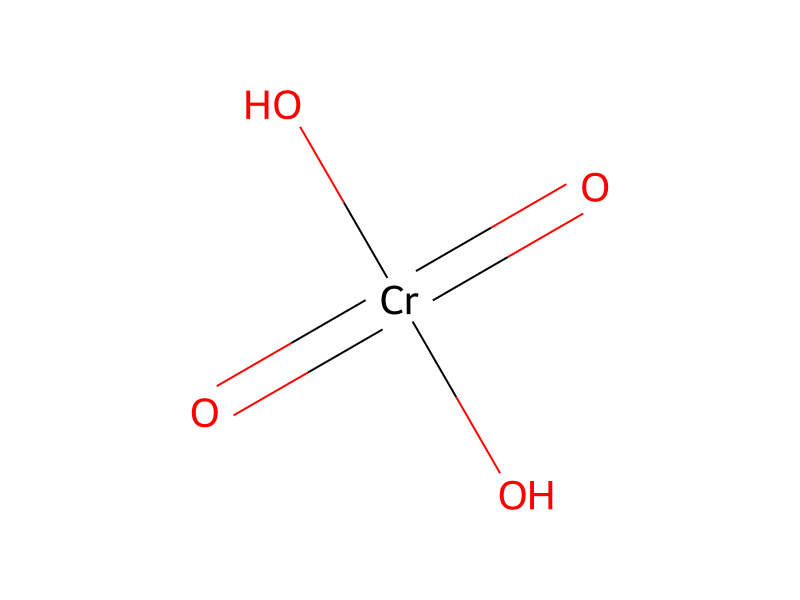


Product 2

Reagents, catalysts & solvents 2


Conditions
- Temperature
- 25 °C
Procedure
Commercial (2S,4R)-1-(tert-butoxycarbonyl)-4-hydroxy-2-pyrrolidinecarboxylic acid (30 g, 0.13 mol) was dissolved in acetone (500 ml). A mechanical stirrer was placed in the flask and the solution stirred vigorously. A freshly made solution of 8N chromic acid was prepared by dissolving chromium trioxide (66.7 g, 0.667 mol) in water (40 ml), adding concentrated sulphuric acid (53.3 ml) and adding enough water to bring the solution volume to 115 ml. The 8N chromic acid solution (115 ml) was then added dropwise over a period of 30 minutes with continued vigorous stirring, the reaction's exotherm being maintained at the optimal temperature of 25° C. by the use of an ice bath. After the complete addition of the chromic acid, the reaction mixture was stirred for a further 15 minutes—maintaining the optimal temperature of 25° C. The reaction mixture was then quenched by the addition of methanol (20 ml). Exotherm controlled by the use of an ice bath and, if necessary, direct addition of a small amount of crushed ice to the reaction mixture itself. The reaction mixture was filtered through a Celite pad and then concentrated in vacuo. The resulting acidic solution was then extracted with ethyl acetate (3×300 ml) and the combined organic layers washed with brine (2×100 ml). Organics then dried with magnesium sulfate and concentrated in vacuo. Crude product recrystallised from ethyl acetate to give the white crystalline product, (2S)-1-(tert-butoxycarbonyl)-4-oxo-2-pyrrolidinecarboxylic acid (22.55 g, 76%). The antipodal intermediate, (2R)-1-(tert-butoxycarbonyl)-4-oxo-2-pyrrolidinecarboxylic acid, was made according to the same protocol, starting from commercial (2R,4S)-1-(tert-butoxycarbonyl)-4-hydroxy-2-pyrrolidinecarboxylic acid.
Workup
- customA mechanical stirrer was placed in the flask
- stirringthe reaction mixture was stirred for a further 15 minutes—
- temperaturemaintaining the optimal temperature of 25° C
- customThe reaction mixture was then quenched by the addition of methanol (20 ml)
- customExotherm controlled by the use of an ice bath
- additionif necessary, direct addition of a small amount of crushed ice to the reaction mixture itself
- filtrationThe reaction mixture was filtered through a Celite pad
- concentrationconcentrated in vacuo
- extractionThe resulting acidic solution was then extracted with ethyl acetate (3×300 ml)
- washthe combined organic layers washed with brine (2×100 ml)
- dry with materialOrganics then dried with magnesium sulfate
- concentrationconcentrated in vacuo
- customCrude product recrystallised from ethyl acetate
Sources & evidence
- ORD record
- ord-fb8ad813c31a4144bd8af44068b783be
- Source dataset
- uspto-grants-2006_10
- Patent number
- US07115639B2
Reaction notes
Loading…