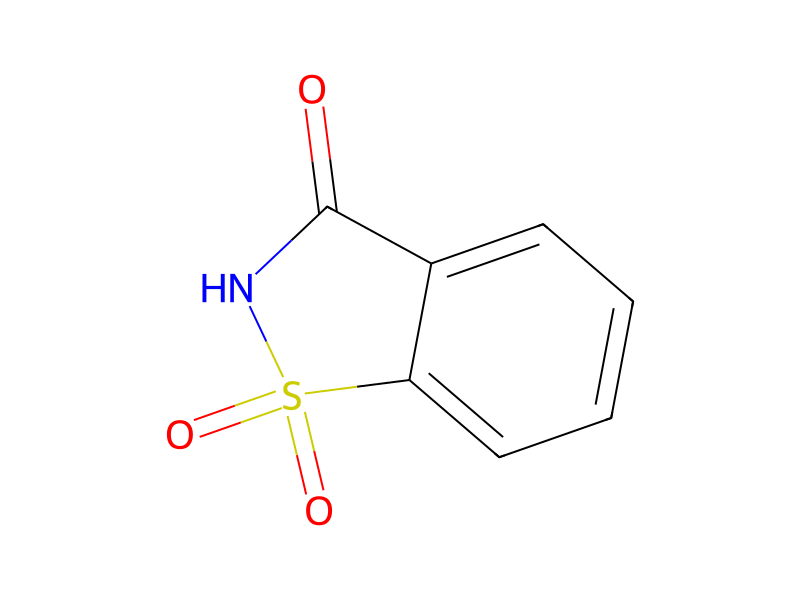
Saccharin → 4-hydroxy-1H-1,2-benzisothiazole-1,1,3(2H)-trione
Reaction equation

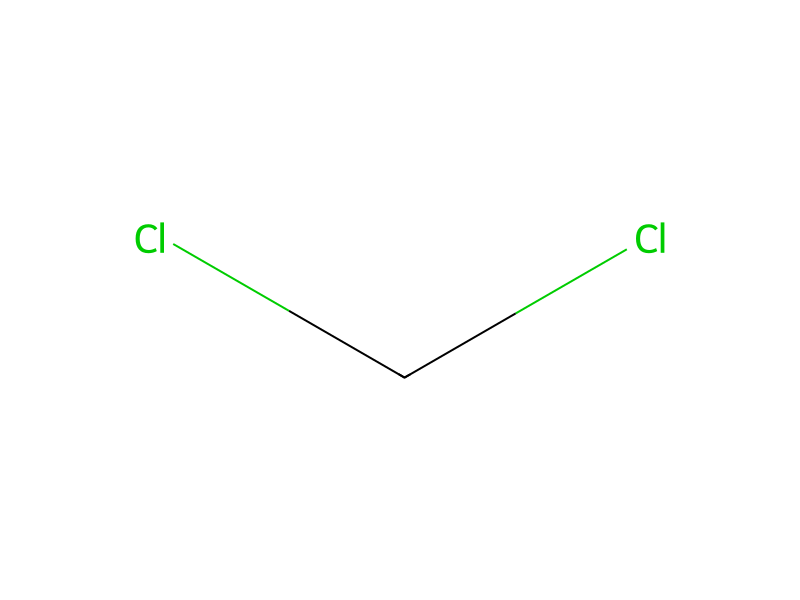
[S:1]1(=[O:12])(=[O:11])[C:5]2[CH:6]=[CH:7][CH:8]=[CH:9][C:4]=2[C:3](=[O:10])[NH:2]1.FC(F)(F)C(O)=[O:16]>C(Cl)Cl.F[B-](F)(F)F.C([N+](CC)(CC)CC)C>[OH:16][C:9]1[C:4]2[C:3](=[O:10])[NH:2][S:1](=[O:11])(=[O:12])[C:5]=2[CH:6]=[CH:7][CH:8]=1Participants
Reactant 2

Product 1

Reagents, catalysts & solvents 2

Procedure
4.6 g (25 mmol) of 1,2-benzisothiazol-3(2H)-one-1,1-dioxide (Saccharin®) were dissolved in a mixture of 65 ml of methylene chloride, 35 ml of trifluoroacetic acid and 2.1 g of tetraethylammonium tetrafluoroborate. The solution was electrolysed at ambient temperature in an electrolysis trough without any separation of the cathode and anode spaces (undivided cell) using a platinum coil (diameter of wire 1 mm, diameter of coil 0.5 cm, length of coil 7.5 cm) as cathode and a cylindrical platinum wire gauze (cylinder diameter 3.5 cm, cylinder height 5 cm, cylinder surface area 5 cm2) as anode. A dry rectifier with potentiometer was used as the source of current. An ammeter connected in series was used to determine the ampere hours and a voltage meter served to measure the potential between the cathode and anode (about 5 to 7 volts). After a charge quantity of about 0.5 Ah had been used up, electrolysis was stopped. The solution was added to ice water. The organic phase was separated off and combined with the chloroform extracts of the aqueous phase. After evaporation of the solvent the residue was distributed between an aqueous iron (III) chloride solution and methylene chloride. 2.7 g of starting material were recovered from the methylene chloride phase. The iron (III) chloride solution was made alkaline and filtered. The filtrate was then acidified and extracted with methylene chloride. After evaporation and recrystallisation from water, 1.2 g of 4-hydroxy-1,2-benzisothiazol-3(2H)-one-1,1-dioxide were obtained. This corresponds to a yield of 58% based on the starting material reacted and a current yield of 67%.
Workup
- customThe solution was electrolysed at ambient temperature in an electrolysis trough without any separation of the cathode and anode spaces (undivided cell)
- additionThe solution was added to ice water
- customThe organic phase was separated off
- customAfter evaporation of the solvent the residue
- custom2.7 g of starting material were recovered from the methylene chloride phase
- filtrationfiltered
- extractionextracted with methylene chloride
- customAfter evaporation and recrystallisation from water
Sources & evidence
- ORD record
- ord-21a22ea25ff04675b7183ee879acc18b
- Source dataset
- uspto-grants-1986_12
- Patent number
- US04626325
Reaction notes
Loading…