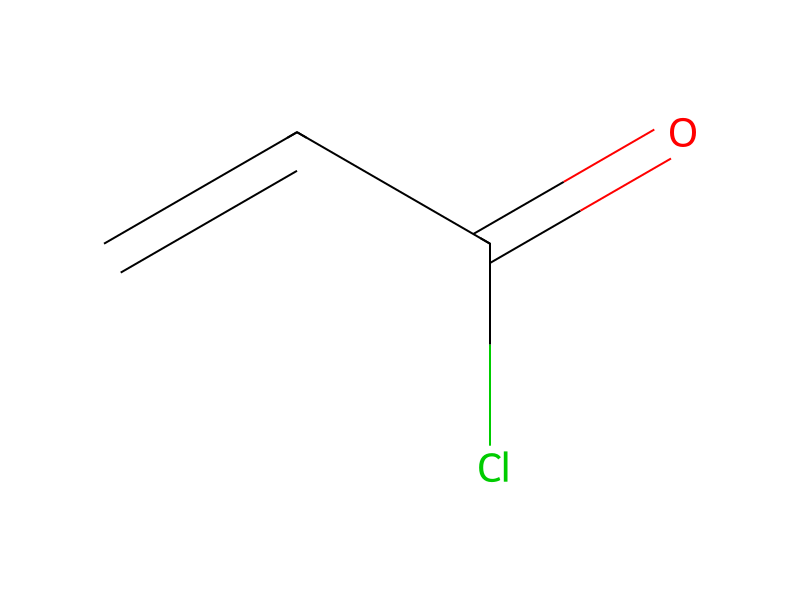
Acryloyl chloride → HCID 86740699, compound
Reaction equation

[CH3:1][O:2][C:3]([C:12]1[CH:17]=[C:16]([C:18]([OH:27])([C:23]([F:26])([F:25])[F:24])[C:19]([F:22])([F:21])[F:20])[CH:15]=[C:14]([C:28]([O:37][CH3:38])([C:33]([F:36])([F:35])[F:34])[C:29]([F:32])([F:31])[F:30])[CH:13]=1)([C:8]([F:11])([F:10])[F:9])[C:4]([F:7])([F:6])[F:5].C(Cl)(=[O:42])C=C>>[C:18]([OH:27])(=[O:42])[CH:16]=[CH2:17].[CH3:38][O:37][C:28]([C:14]1[CH:15]=[C:16]([C:18]([OH:27])([C:23]([F:24])([F:25])[F:26])[C:19]([F:20])([F:21])[F:22])[CH:17]=[C:12]([C:3]([O:2][CH3:1])([C:4]([F:5])([F:6])[F:7])[C:8]([F:9])([F:10])[F:11])[CH:13]=1)([C:29]([F:32])([F:31])[F:30])[C:33]([F:36])([F:35])[F:34]Participants


Procedure
A solution of 14.00 g (0.232 mole) 1,3-bis-(2-methoxyhexafluoro-5-(2-hydroxyhexafluoro-2-propyl)-benzene (II) in 40 ml of Freon 113 was stirred magnetically in a 200 ml 3-deck flask equipped with a dropping funnel, thermometer, dry ice-acetone condenser and drying tube (CaCl2). 24.6 g of triethylamine dissolved in 15 ml of Freon 113 was added dropwise during 20 minutes with slight exotherm. An external cooling bath (ice water) was applied. Then a second dropping funnel charged with 2.20 g (0.024 mole) of acryloyl chloride (III) dissolved in 15 ml of Freon 113 was quickly substituted in place of the empty funnel. The latter charge was added during 30 minutes at 10°-20° C. After stirring an additional 2 hours, the resulting white slurry was vacuum filtered (60 ml C filter -3 g of Celite cake). Flash evaporation of the filtrate left 15.5 g of honey-like residue that readily crystallized (mp 58°-62° C.) and analyzed 80 mole % diether acrylate (IV), 17% unreacted diether o1 (II), and 3% acrylic anhydride. Trituration of this mixture in 100 ml of a 2% sodium hydroxide solution followed by neutralization led to 13.1 g of white crystals (mp 61°-62° C.) analyzing 90.6% (IV) and 9.4% (II), with no acrylic anhydride. The 13.1 g of crude ester was submitted again to the customary esterification procedure using 1.21 g of triethylamine and 1.07 g of acryloyl chloride. This led to 12.9 g of crystals analyzing 94.3 mole % (IV) and 5.7% acrylic anhydride. Workup in 2% sodium hydroxide solution led to 12.6 g of white crystals (mp 65°-66° C.) of 100% purity (IV) by GLC. Recrystallization from petroleum ether at -70° F. (-57° C.) gave 11.7 g analytical (IV) as extremely water repellent white crystals; 76.7% yield; mp 66° C. By analysis as calculated for C20H12F18O4 : C, 36.49; H, 1.84; F, 51.95; as found: C, 36.58; H, 1.79; F, 51.96.
Workup
- customequipped with a dropping funnel
- dry with materialthermometer, dry ice-acetone condenser and drying tube (CaCl2)
- dissolution24.6 g of triethylamine dissolved in 15 ml of Freon 113
- additionwas added dropwise during 20 minutes with slight exotherm
- customAn external cooling bath (ice water) was applied
- dissolutiondissolved in 15 ml of Freon 113
- additionThe latter charge
- additionwas added during 30 minutes at 10°-20° C
- filtrationfiltered
- filtration(60 ml C filter -3 g of Celite cake)
- customFlash evaporation of the filtrate
- waitleft 15.5 g of honey-like residue
- customthat readily crystallized (mp 58°-62° C.)
- customRecrystallization from petroleum ether at -70° F. (-57° C.)
Sources & evidence
- ORD record
- ord-ca43bf42b1264934a42ddf5e116cf8e0
- Source dataset
- uspto-grants-1986_12
- Patent number
- US04633023
Reaction notes
Loading…