Sulfuric Acid → Beta-Lapachone
Reaction equation

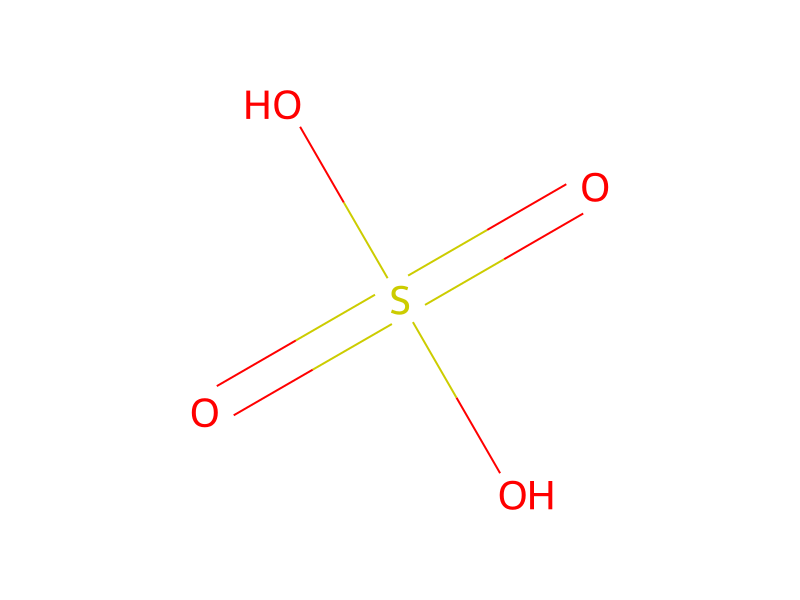
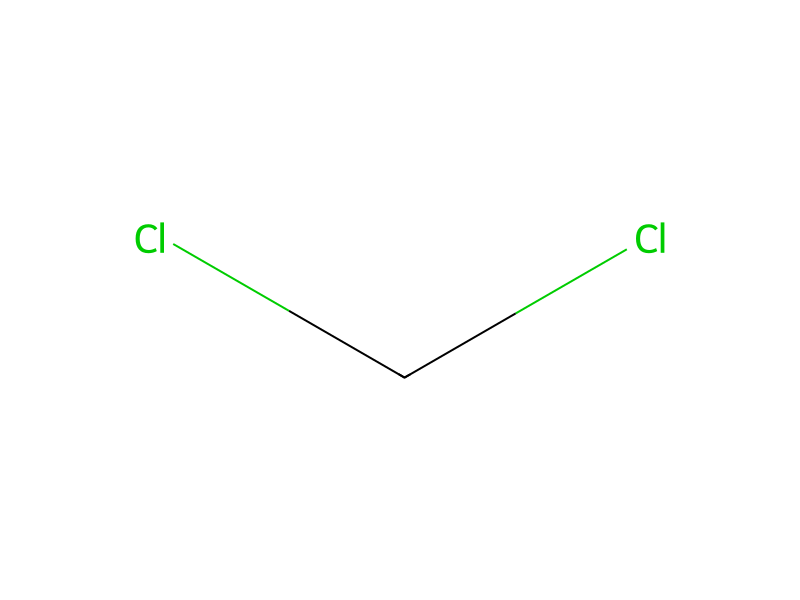
[CH3:1][C:2]([CH3:18])=[CH:3][CH2:4][C:5]1[C:15](=[O:16])[C:14]2[CH:13]=[CH:12][CH:11]=[CH:10][C:9]=2[C:7](=[O:8])[C:6]=1[OH:17].S(=O)(=O)(O)O>C(Cl)Cl>[CH3:1][C:2]1([CH3:18])[O:16][C:15]2[C:14]3[CH:13]=[CH:12][CH:11]=[CH:10][C:9]=3[C:7]([C:6](=[O:17])[C:5]=2[CH2:4][CH2:3]1)=[O:8]Participants
Reactant 2

Product 1

Reagents, catalysts & solvents 1
Procedure
17.4 g (0.10M) of 2-hydroxy-1,4-naphthoquinone was dissolved in 120 ml of DMSO, and 0.88 g (0.11M) of LiH was gradually added thereto. Here, this should be done with care because hydrogen evolves. The reaction solution was stirred, and after confirming no further production of hydrogen, was additionally stirred for another 30 min. Then, 14.8 g (0.11M) of methallyl bromide (1-bromo-2-methylpropene) and 3.35 g (0.025M) of LiI were gradually added thereto. The reaction solution was heated to 45° C. and then stirred vigorously for 12 hours at that temperature. The reaction solution was cooled below 10° C., and 80 g of ice was first added and 250 ml of water was then added. Thereafter, 25 ml of concentrated HCl was gradually added to maintain the resulting solution at an acidic pH>1.200 ml of CH2Cl2 was added to the reaction mixture which was then shaken vigorously to separate two layers. The aqueous layer was extracted once again with addition of 70 ml of CH2Cl2 and was combined with the previously extracted organic layer. Two materials were confirmed to be formed newly by TLC and were subsequently used without any particular separation process. The organic layer was concentrated by distillation under reduced pressure, dissolved again in xylene and then refluxed for 8 hours. In this process, two materials on TLC were combined into one, thereby obtaining a relatively pure Lapachol derivative. The thus-obtained Lapachol derivative was mixed with 80 ml of sulfuric acid and stirred vigorously at room temperature for 10 min, and 200 g of ice was added thereto to complete the reaction. 80 ml of CH2Cl2 was added to the reaction materials which were then shaken vigorously. Thereafter, a CH2Cl2 layer was separated and washed with 5% NaHCO3. An aqueous layer was extracted once again using 50 ml of CH2Cl2, washed with 5% NaHCO3 and combined with the previously extracted organic layer. The organic layer was dried over MgSO4 and concentrated to give impure β-Lapachone derivative (Compound 4). The thus-obtained β-Lapachone derivative was recrystallized from isopropanol, thereby obtaining 12.21 g of pure Compound 4.
Workup
- customthe reaction
- stirringwere then shaken vigorously
- customThereafter, a CH2Cl2 layer was separated
- washwashed with 5% NaHCO3
- extractionAn aqueous layer was extracted once again
- washwashed with 5% NaHCO3
- dry with materialThe organic layer was dried over MgSO4
- concentrationconcentrated
Sources & evidence
- ORD record
- ord-b8936ead97d444dd90efb24ed3295cc8
- Source dataset
- uspto-grants-2013_06
- Patent number
- US08466141B2
Reaction notes
Loading…