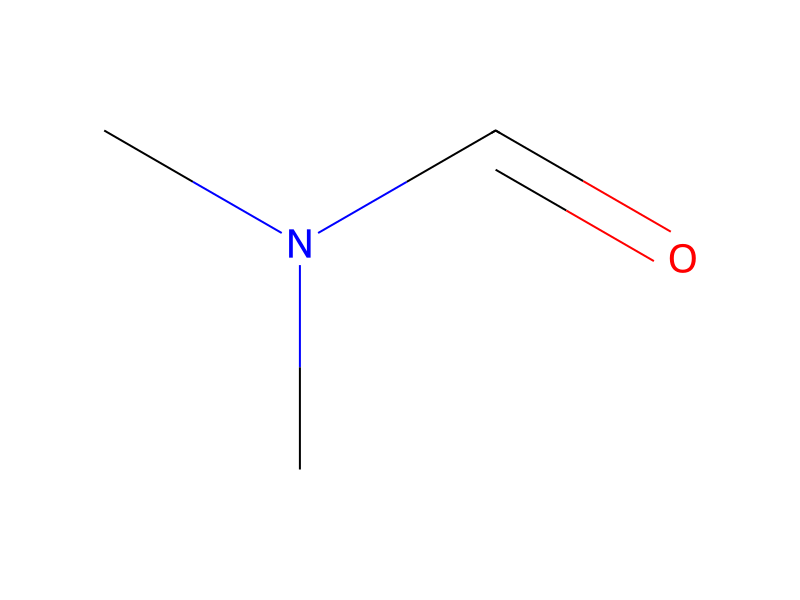
Dimethylformamide → 91374-26-4
Reaction equation

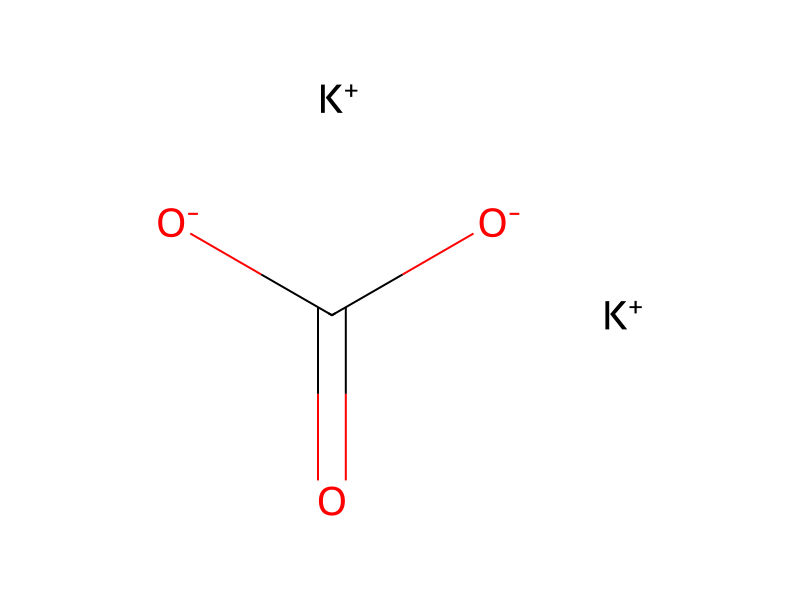
Br.[NH2:2][CH2:3][CH2:4][C:5]1[CH:13]=[CH:12][C:11](O)=[C:10]2[C:6]=1[CH2:7][C:8](=[O:15])[NH:9]2.CN(C)C=O.[Cl:21]C1N(C2C=CC=CC=2)N=NN=1.C(=O)([O-])[O-].[K+].[K+]>O>[ClH:21].[NH2:2][CH2:3][CH2:4][C:5]1[CH:13]=[CH:12][CH:11]=[C:10]2[C:6]=1[CH2:7][C:8](=[O:15])[NH:9]2Participants


Procedure
A mixture of 2.73 g (10.0 mmoles) of 4-(2-aminoethyl)-7-hydroxy-2(3H)-indolone hydrobromide (U.S. Pat. No. 4,314,944), 200 cc of dimethylformamide, 1.86 g (10.3 mmoles) of 5-chloro-1-phenyl-1H-tetrazole, 10 cc of water and 2.9 g (21 mmoles) of anhydrous potassium carbonate is stirred at room temperature for 2 days or until thin layer analysis indicates that no starting material remains. The reaction is filtered and the filtrate is acidified with dil. hydrochloric acid, concentrated in vacuo and the residue triturated with abs. ethanol. The triturate is clarified with charcoal and evaporated to dryness in vacuo. The hydrochloride salt of 4-(2-aminoethyl)-7-(1-phenyl-1H-tetrazol-5-yloxy)-2(3H)-indolone is hydrogenated directly in 200 cc of glacial acetic acid using 50% by substrate weight of 10% palladium-on-carbon at 50 p.s.i. for 20 hours at 50°. The warm reaction mixture is filtered. The catalyst is washed thoroughly with hot acetic acid. After the filtrate is concentrated in vacuo, the residue is stripped several times from dilute hydrochloric acid and crystallized from ethanol to give 4-(2-aminoethyl)-2(3H)-indolone hydrochloride.
Workup
- filtrationThe reaction is filtered
- concentrationconcentrated in vacuo
- customthe residue triturated with abs
- customevaporated to dryness in vacuo
- customThe warm reaction mixture
- filtrationis filtered
- washThe catalyst is washed thoroughly with hot acetic acid
- concentrationAfter the filtrate is concentrated in vacuo
- customcrystallized from ethanol
Sources & evidence
- ORD record
- ord-d97ac28b3aa54a4f942b7f69d1c5b740
- Source dataset
- uspto-grants-1984_06
- Patent number
- US04452808
Reaction notes
Loading…