Ethylene Glycol → 2,2-Dibutyl-1,3,2-dioxastannolane
Reaction equation

[CH2:1]([Sn:5](=[O:10])[CH2:6][CH2:7][CH2:8][CH3:9])[CH2:2][CH2:3][CH3:4].[CH2:11](O)[CH2:12][OH:13]>C1C=CC=CC=1>[CH2:1]([Sn:5]1([CH2:6][CH2:7][CH2:8][CH3:9])[O:13][CH2:12][CH2:11][O:10]1)[CH2:2][CH2:3][CH3:4]Participants
4
Reactant 2

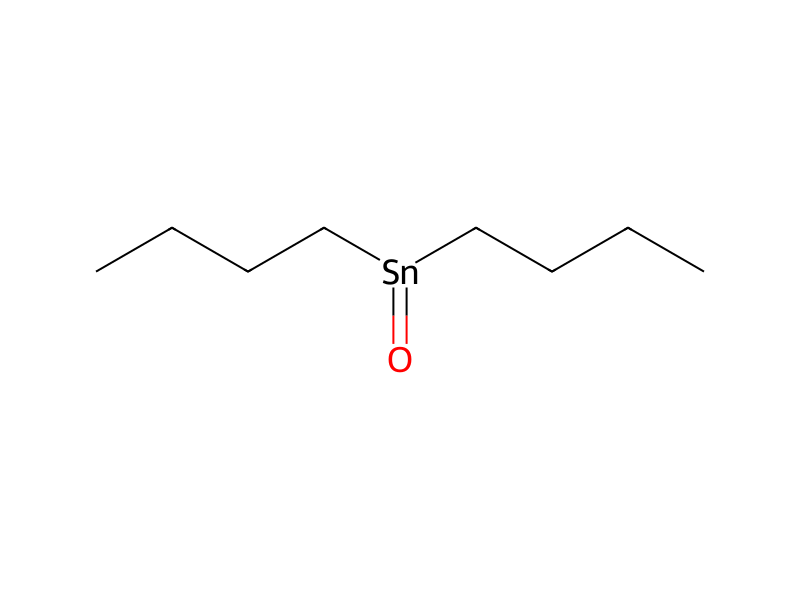
Product 1

Reagents, catalysts & solvents 1

Procedure
24.98 g (0.1 mol) of dibutyltin oxide and 6.21 g (0.1 mol) of ethylene glycol were introduced into a 500 ml reaction vessel equipped with a Dean-Stark device, and the atmosphere in the reaction vessel was replaced by argon. 250 ml of benzene was added, and the mixture was dehydrated by azeotropic distillation at 93° C. and stirred for 4 hours during which it became an uniform solution. Then, the solution was filtered while it was hot. The benzene was distilled off under reduced pressure, and the resulting white solids were dried at 60° C. for 3 hours in vaccuo to give 1,1-dibutylstanna-2,5-dioxacyclopentane, 27.6 g (94.2% yield).
Workup
- customequipped with a Dean-Stark device
- distillationthe mixture was dehydrated by azeotropic distillation at 93° C.
- filtrationThen, the solution was filtered while it
- distillationThe benzene was distilled off under reduced pressure
- customthe resulting white solids were dried at 60° C. for 3 hours in vaccuo
Sources & evidence
- ORD record
- ord-18dd816d8fed49c387b95e74ab9f11b5
- Source dataset
- uspto-grants-2003_04
- Patent number
- US06545112B2
Reaction notes
Loading…