Pentaerythritol → 2,2-Dibutyl-1,3,2-dioxastanninane
Reaction equation

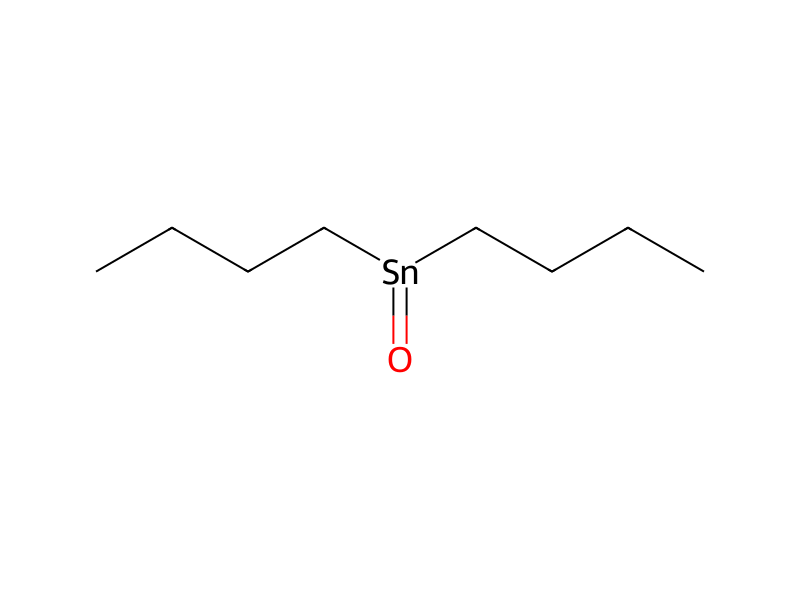
[CH2:1]([Sn:5](=[O:10])[CH2:6][CH2:7][CH2:8][CH3:9])[CH2:2][CH2:3][CH3:4].[OH:11][CH2:12][C:13](CO)(CO)[CH2:14]O>C1(C)C=CC=CC=1>[CH2:1]([Sn:5]1([CH2:6][CH2:7][CH2:8][CH3:9])[O:11][CH2:12][CH2:13][CH2:14][O:10]1)[CH2:2][CH2:3][CH3:4]Participants
Reactant 2

Product 1

Reagents, catalysts & solvents 1

Procedure
49.78 g (0.2 mol) of dibutyltin oxide and 13.615 g (0.1 mol) of pentaerythritol were introduced into a 1000 ml reaction vessel equipped with a Dean-Stark device, and the atmosphere in the reaction vessel was replaced by argon. 500 ml of toluene was added, and the mixture was dehydrated by azeotropic distillation at 130° C. and stirred for 26.5 hours during which it became an uniform solution. After left and cooled to room temperature, the precipitated white solids were filtered. The white solids were heated and dissolved in 300 ml of toluene, and cooled gradually to room temperature, and the precipitated white solids were filtered. The resulting white solids were dried at 60° C. for 5 hours in vaccuo to give 4,4′-spirobi[1,1-dibutylstanna-2,6-dioxacyclohexane, 52.3 g (87.5% yield).
Workup
- customequipped with a Dean-Stark device
- distillationthe mixture was dehydrated by azeotropic distillation at 130° C.
- waitAfter left
- filtrationthe precipitated white solids were filtered
- temperatureThe white solids were heated
- dissolutiondissolved in 300 ml of toluene
- temperaturecooled gradually to room temperature
- filtrationthe precipitated white solids were filtered
- customThe resulting white solids were dried at 60° C. for 5 hours in vaccuo
Sources & evidence
- ORD record
- ord-5195132024384b2cb4527de427f4ef1c
- Source dataset
- uspto-grants-2003_04
- Patent number
- US06545112B2
Reaction notes
Loading…