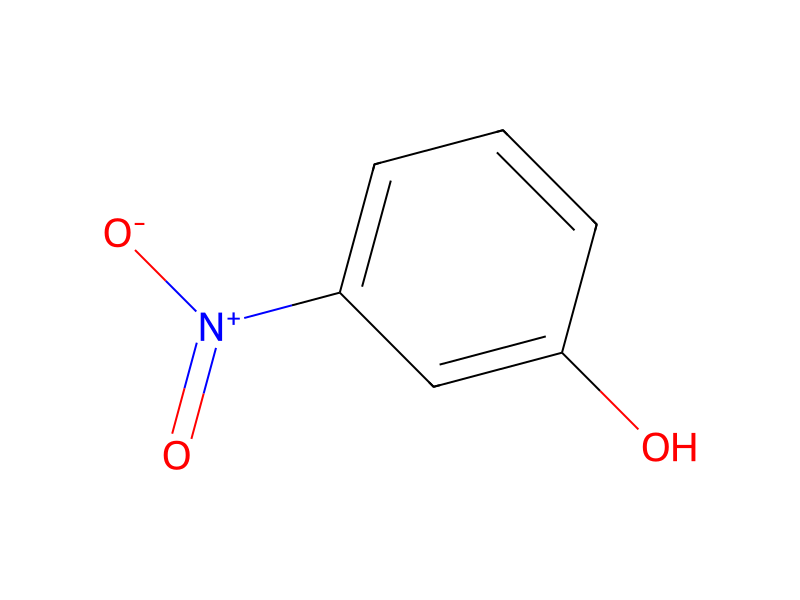
3-Nitrophenol → HCID 20287995, compound
Reaction equation

[OH-].[Na+].[N+:3]([C:6]1[CH:7]=[C:8]([OH:12])[CH:9]=[CH:10][CH:11]=1)([O-:5])=[O:4].[Cl:13][C:14]1[C:19](Cl)=[N:18][CH:17]=[CH:16][N:15]=1>C(O)C>[Cl:13][C:14]1[C:19]([O:12][C:8]2[CH:9]=[CH:10][CH:11]=[C:6]([N+:3]([O-:5])=[O:4])[CH:7]=2)=[N:18][CH:17]=[CH:16][N:15]=1Participants
5
Reactant 3


Product 1

Reagents, catalysts & solvents 1

Procedure
In a 250-ml single-necked, round-bottomed flask containing a solution of 3.0 g (75 mmol) of sodium hydroxide in 100 ml of absolute ethanol was added 9.28 g (67 mmol) of 3-nitrophenol at which point the solution turned dark red. To the dark red solution, 10.0 g (66 mmol) of 2,3-dichloropyrazine was added and the resulting solution refluxed for 162 hours. The reaction mixture was cooled and concentrated. Upon pouring the concentrate into approximately 300 ml of water, an off-white solid precipitated which was collected by filtration. Recrystallization from absolute ethanol gave the product, 2-chloro-3-(3-nitrophenoxy)pyrazine, (46% yield) as white needles, mp 119°-121° C.
Workup
- temperaturethe resulting solution refluxed for 162 hours
- temperatureThe reaction mixture was cooled
- concentrationconcentrated
- additionUpon pouring the
- concentrationconcentrate into approximately 300 ml of water
- customan off-white solid precipitated which
- filtrationwas collected by filtration
- customRecrystallization from absolute ethanol
Sources & evidence
- ORD record
- ord-d0be66b2fc944091853bf40e48a5cbc6
- Source dataset
- uspto-grants-1981_03
- Patent number
- US04254125
Reaction notes
Loading…