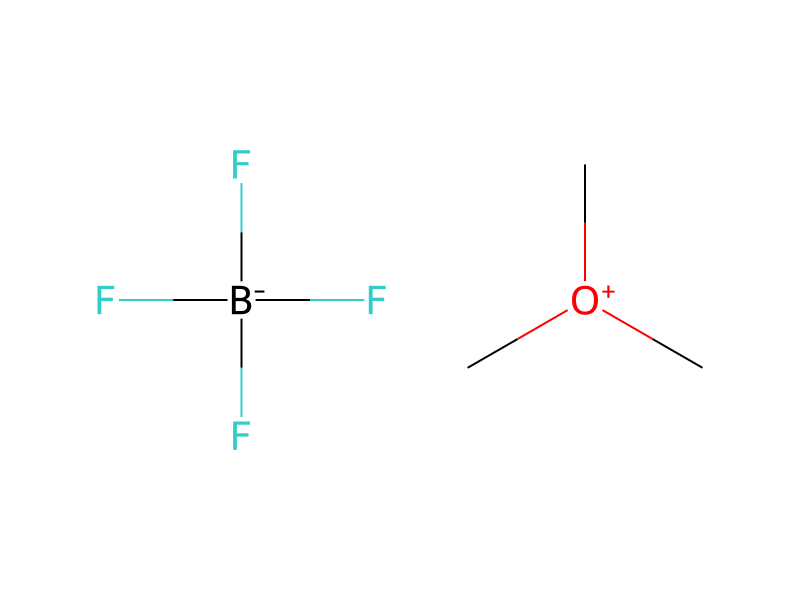
Oxonium, trimethyl-, tetrafluoroborate(1-) (1:1) → HCID 20571382, compound
Reaction equation

[Cl:1][C:2]1[CH:7]=[C:6]([C:8]([F:11])([F:10])[F:9])[CH:5]=[CH:4][C:3]=1[CH:12]([CH:16]([CH3:18])[CH3:17])[C:13]([NH2:15])=[O:14].Br[CH:20](C1C(C(N)=O)C1(C)C)C(Br)(Cl)Cl.F[B-](F)(F)F.C[O+](C)C>>[Cl:1][C:2]1[CH:7]=[C:6]([C:8]([F:11])([F:10])[F:9])[CH:5]=[CH:4][C:3]=1[CH:12]([CH:16]([CH3:18])[CH3:17])[C:13](=[NH:15])[O:14][CH3:20]Participants
4


Procedure
In like manner, each of 2-(2-chloro-4-trifluoromethylphenyl)-3-methylbutyramide and 3-(1,2-dibromo-2,2-dichloroethyl)-2,2-dimethylcyclopropaneamide is reacted with trimethyloxonium tetrafluoroborate, giving methyl 2-(2-chloro-4-trifluoromethylphenyl)-3-methylbutanimidate and methyl 2-(1,2-dibromo-2,2-dichloroethyl)-2,2-dimethylcyclopropanimidate, respectively. Each of these imidates is then reacted with 3-phenoxybenzyl alcohol to yield, respectively, 3-phenoxybenzyl 2-(2-chloro-4-trifluoromethylphenyl)-3-methylbutanimidate and 3-phenoxybenzyl 2-(1,2-dibromo-2,2-dichloroethyl)-2,2-dimethylcyclopropanimidate.
Sources & evidence
- ORD record
- ord-1207b497377c4013bfe6bd9dae6481db
- Source dataset
- uspto-grants-1981_03
- Patent number
- US04254264
Reaction notes
Loading…