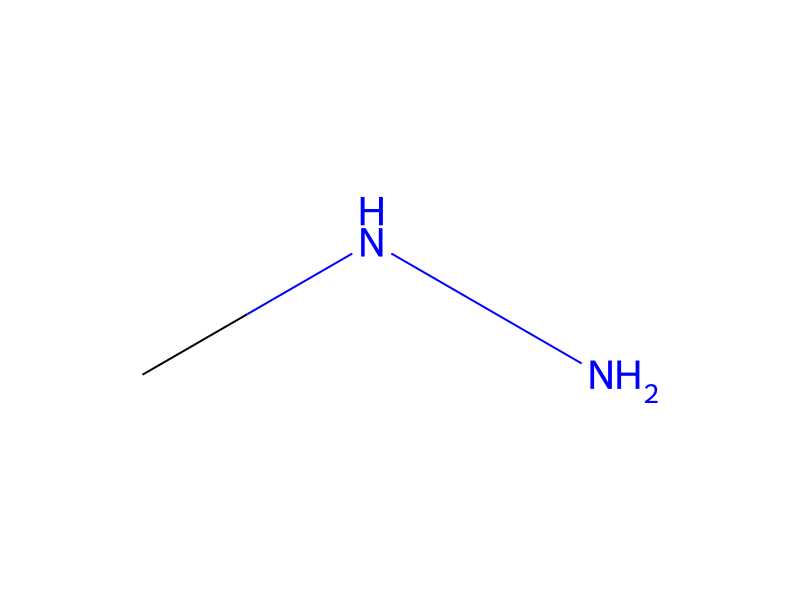
Methylhydrazine → 2,4-Diamino-6-(1-methylhydrazino)pyrimidine
Reaction equation

Cl[C:2]1[N:7]=[C:6]([NH2:8])[N:5]=[C:4]([NH2:9])[CH:3]=1.[CH3:10][NH:11][NH2:12]>CO>[NH2:8][C:6]1[N:5]=[C:4]([NH2:9])[CH:3]=[C:2]([N:11]([CH3:10])[NH2:12])[N:7]=1Participants
4
Reactant 2

Product 1

Reagents, catalysts & solvents 1

Procedure
To a refluxing solution of 6-chloro-2,4-diaminopyrimidine (4.0 g) in anhydrous methanol (40 ml) was added methylhydrazine (3.2 g). After 18 hours the refluxing mixture was allowed to cool to room temperature under a nitrogen atmosphere in order that the product could crystallise out. The white solid (3.0 g) was collected by filtration and dried under reduced pressure at 70° C. Recrystallisation of the product from methanol/methylhydrazine (50/l) gave straw-coloured crystals of 2,4-diamino-6-(1-methylhydrazino)pyrimidine (1.92 g; 56% of theoretical yield; M.P. 214°-217° C. decomposition).
Workup
- customcould crystallise out
- filtrationThe white solid (3.0 g) was collected by filtration
- customdried under reduced pressure at 70° C
- customRecrystallisation of the product from methanol/methylhydrazine (50/l)
Sources & evidence
- ORD record
- ord-316f168b166d4fa3aaad4f3bb9549663
- Source dataset
- uspto-grants-1981_03
- Patent number
- US04255427
Reaction notes
Loading…