2-Chloro-6,7-dimethoxy-4-quinazolinamine → HCID 9805525, compound
Reaction equation

[NH2:1][C:2]1[C:11]2[C:6](=[CH:7][C:8]([O:14][CH3:15])=[C:9]([O:12][CH3:13])[CH:10]=2)[N:5]=[C:4](Cl)[N:3]=1.[CH3:17][O:18][C:19]([C:21]1[C:26]([NH2:27])=[N:25][C:24]([NH:28][CH:29]2[CH2:34][CH2:33][NH:32][CH2:31][CH2:30]2)=[C:23]([Cl:35])[N:22]=1)=[O:20]>C(O)CC(C)C>[CH3:17][O:18][C:19]([C:21]1[C:26]([NH2:27])=[N:25][C:24]([NH:28][CH:29]2[CH2:34][CH2:33][N:32]([C:4]3[N:3]=[C:2]([NH2:1])[C:11]4[C:6](=[CH:7][C:8]([O:14][CH3:15])=[C:9]([O:12][CH3:13])[CH:10]=4)[N:5]=3)[CH2:31][CH2:30]2)=[C:23]([Cl:35])[N:22]=1)=[O:20]Participants
Reactant 2
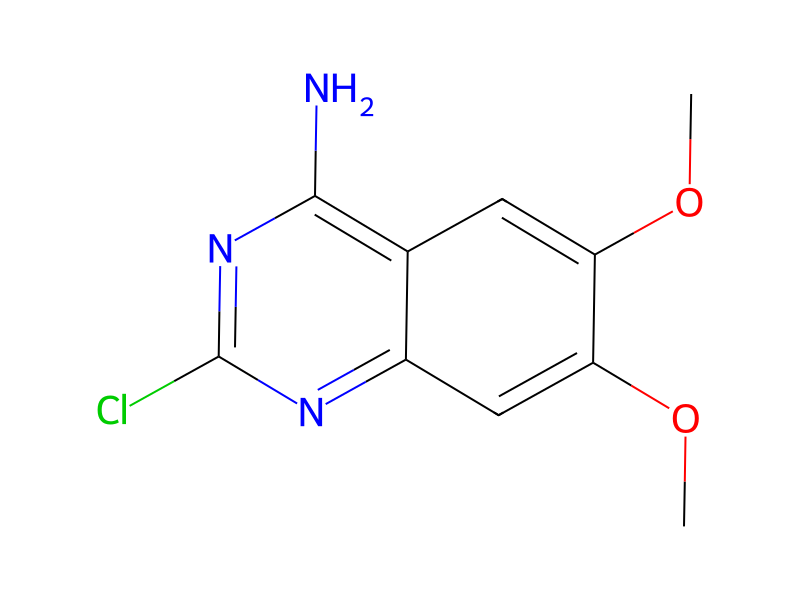

Product 1

Reagents, catalysts & solvents 1

Conditions
- Temperature
- 120 °C
Procedure
4-Amino-2-chloro-6,7-dimethoxyquinazoline (0.74 g, 3.1 mmol) was added to a solution of (36) (1.0 g, 3.2 mmol) in isoamyl alcohol (20 mL) at 25° C. The mixture was heated to 120° C. and maintained at that temperature for 12 h. The reaction mixture was then cooled to room temperature and the desired product was filtered and rinsed with acetone to give 0.75 g (49%) of the compound (1): TLC (Rf =0.50; 10% MeOH/CH2Cl2); 1H NMR (CDCl3) δ 6.93 (s, 1H), 6.82 (s, 1H), 5.44 (d, 1H, J=7.8), 5.21 (br s, 2H), 4.77 (d, 2H, J=13.7), 4.19 (m, 1H), 3.97 (s, 3H), 3.92 (s, 3H), 3.90 (s, 3H), 3.12 (t, 2H, J=11.3), 2.12 (d, 2H, J=12.6), 1.56 (m, 2H); 13C NMR (CDCl3) δ 166.6, 160.7, 158.4, 155.6, 155.4, 150.8, 149.6, 146.1, 121.5, 110.6, 105.8, 102.8, 101.7, 56.3, 56.1, 51.9, 48.9, 43.0, 31.8; HRMS (FAB) m/z 621.0766 (M+Cs)+ (C21H25N8O4Cl requires 621.0742); Anal. (C21H25N8O4Cl·1/2HCl·1/4CH3OH) C, H, N.
Workup
- temperaturemaintained at that temperature for 12 h
- temperatureThe reaction mixture was then cooled to room temperature
- filtrationthe desired product was filtered
- washrinsed with acetone
Sources & evidence
- ORD record
- ord-20ace879bec24e278a7cac8cb27e3008
- Source dataset
- uspto-grants-2000_12
- Patent number
- US06156758
Reaction notes
Loading…