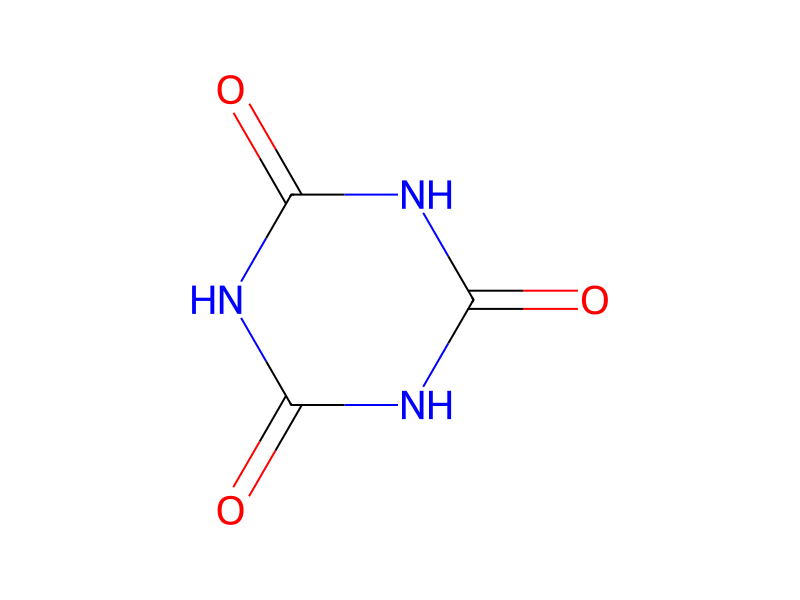
Trichloroisocyanuric Acid → Cyanuric acid
Reaction equation

C(OC/C=C(/CCC=C(C)C)\C)(=O)C.Cl[N:16]1[C:21](=[O:22])[N:20](Cl)[C:19](=[O:24])[N:18](Cl)[C:17]1=[O:26]>CCCCCC>[NH:16]1[C:21](=[O:22])[NH:20][C:19](=[O:24])[NH:18][C:17]1=[O:26]Participants
4
Reactant 2


Product 1
Reagents, catalysts & solvents 1

Procedure
In 100 ml of n-hexane was dissolved 40 g (0.204 mol) of geranyl acetate, and 17.1 g (0.071 mol) of trichloroisocyanuric acid was added slowly and maintained between -10° C. to 0° C. for six hours. After the reaction, excessive trichloroisocyanuric acid and by-produced isocyanuric acid were removed by filtration. The filtrate was washed with an aqueous sodium hydrogencarbonate solution and water, dried over anhydrous magnesium sulfate, and the solvent was evaporated to yield a crude product. The crude product obtained was purified by silica gel chromatography to provide 6-chloro-3,7-dimethyl-2,7-octadiene-1-acetate (hereinafter, compound (a)) in a yield of 86% in the form of pale yellow oil.
Workup
- additionwas added slowly
- temperaturemaintained between -10° C. to 0° C. for six hours
Sources & evidence
- ORD record
- ord-d19f17aa641345c2a1628ac8b5293dcb
- Source dataset
- uspto-grants-2000_12
- Patent number
- US06160181
Reaction notes
Loading…