Ammonia → Dicyclohexylamine
Reaction equation

[CH:1]1([NH:7][CH:8]2[CH2:13][CH2:12][CH2:11][CH2:10][CH2:9]2)[CH2:6][CH2:5][CH2:4][CH2:3][CH2:2]1.C(CCC(N1C(C(O)=O)CC2C(=CC=CC=2)C1)=S)(=O)C1C=CC=CC=1.N>CO>[CH:8]1([NH:7][CH:1]2[CH2:2][CH2:3][CH2:4][CH2:5][CH2:6]2)[CH2:9][CH2:10][CH2:11][CH2:12][CH2:13]1Participants
4
Reactant 2


Product 1
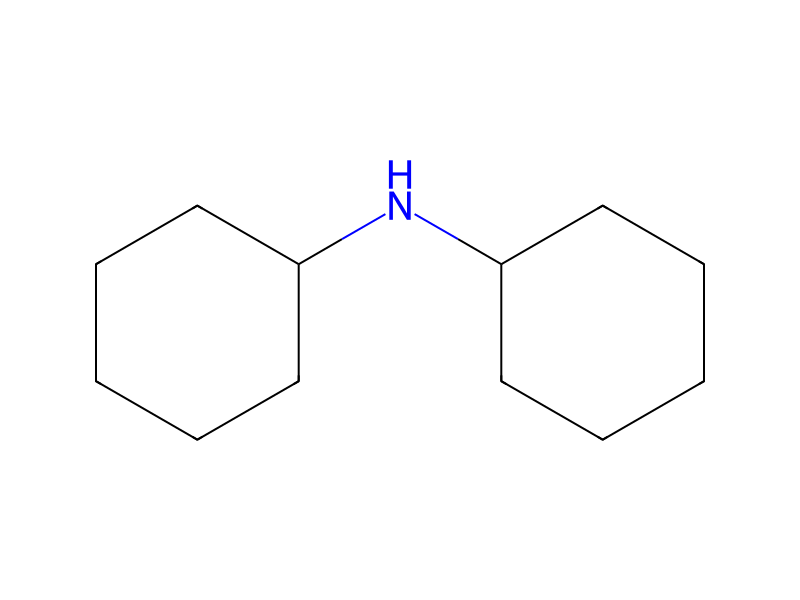
Reagents, catalysts & solvents 1

Procedure
1.4 g of 2-(3-benzoylthio-propionyl)-1,2,3,4-tetrahydroisoquinoline-3-carboxylic acid dicyclohexylamine salt are dissolved in 20 ml of methanol, and 20 ml of 8 % aqueous ammonia are added thereto. The mixture is stirred at room temperature overnight in nitrogen gas atmosphere. The reaction mixture is condensed to dryness under reduced pressure, and the residue is washed with ether. 0.85 g of 2-(3-mercaptopropionyl)-1,2,3,4-tetrahydroisoquinoline-3-carboxylic acid.dicyclohexylamine salt is thereby obtained. Yield: 74.7 % M.p. 193°-194° C.(decomp.) (This product begins to gradually decompose at 176° C.)
Workup
- customcondensed to dryness under reduced pressure
- washthe residue is washed with ether
Sources & evidence
- ORD record
- ord-af5c46a9bb91446588035dedaca49ccf
- Source dataset
- uspto-grants-1981_03
- Patent number
- US04256751
Reaction notes
Loading…