Diethyl Ether → Dicyclohexylamine
Reaction equation

[CH:1]1([NH:7][CH:8]2[CH2:13][CH2:12][CH2:11][CH2:10][CH2:9]2)[CH2:6][CH2:5][CH2:4][CH2:3][CH2:2]1.C(SC[C@@H](C)C(N1[C@H](C(O)=O)CC2C(=CC=CC=2)C1)=O)(=O)C1C=CC=CC=1.CCOCC.CCCCCC>N.CO>[CH:8]1([NH:7][CH:1]2[CH2:2][CH2:3][CH2:4][CH2:5][CH2:6]2)[CH2:9][CH2:10][CH2:11][CH2:12][CH2:13]1Participants
Reactant 3



Product 1
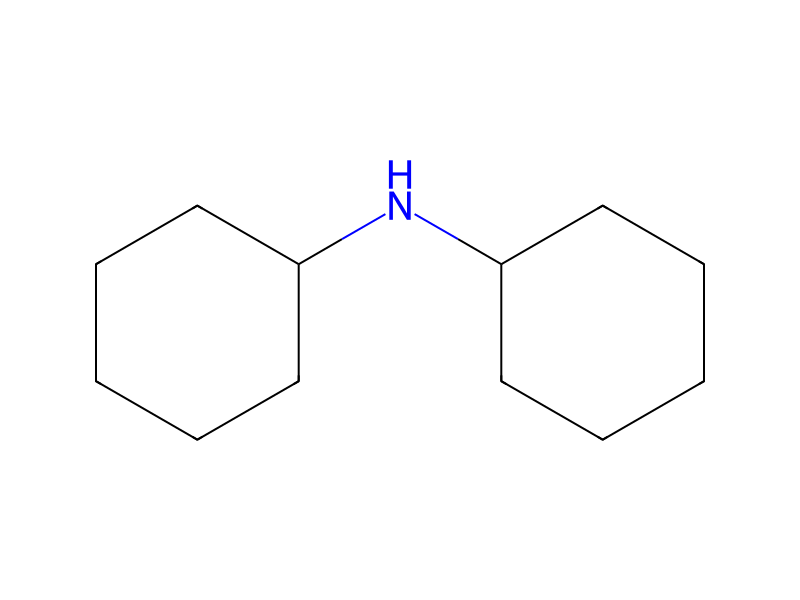
Reagents, catalysts & solvents 2


Procedure
1.26 g of (3S)-2-[(2S)-3-benzoylthio-2-methylpropionyl]-1,2,3,4-tetrahydroisoquinoline-3-carboxylic acid dicyclohexylamine salt are suspended in a mixture of 15 ml of 10 % aqueous ammonia and 5 ml of methanol. The mixture is stirred at room temperature for 3.5 hours in nitrogen gas atmosphere. The reaction mixture is condensed to dryness under reduced pressure, and a mixture of ether and n-hexane is added thereto. Crystalline precipitates are collected by filtration, washed with ether and recrystallized from ethanol. 0.85 g of (3S)-2-[(2S)-3-mercapto-2-methylpropionyl]-1,2,3,4-tetrahydroisoquinoline-3-carboxylic acid.dicyclohexylamine salt is thereby obtained as colorless crystals. Yield: 82.7 % M.p. 191°-192° C.(decomp.) (This product begins to gradually decompose at about 172° C.). All the physico-chemical properties of this product are identical with those of the sample obtained in Example 1-(3).
Workup
- customcondensed to dryness under reduced pressure
- additionis added
- customCrystalline precipitates
- filtrationare collected by filtration
- washwashed with ether
- customrecrystallized from ethanol
Sources & evidence
- ORD record
- ord-f33836363bdc44cba9ffa2e698cc68c7
- Source dataset
- uspto-grants-1981_03
- Patent number
- US04256751
Reaction notes
Loading…