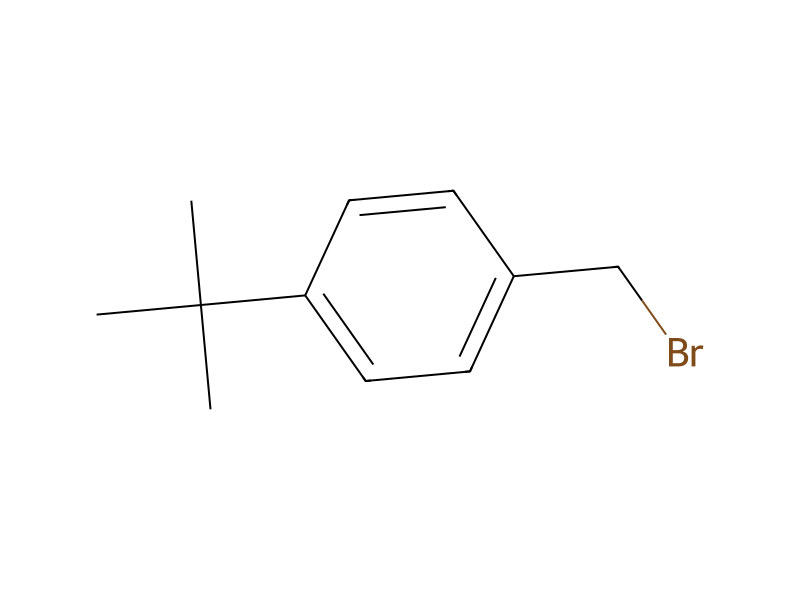
4-tert-Butyltoluene → 1-(Bromomethyl)-4-(1,1-dimethylethyl)benzene
Reaction equation

[C:1]([C:5]1[CH:10]=[CH:9][C:8]([CH3:11])=[CH:7][CH:6]=1)([CH3:4])([CH3:3])[CH3:2].[Br:12]Br>>[C:1]([C:5]1[CH:6]=[CH:7][C:8]([CH2:11][Br:12])=[CH:9][CH:10]=1)([CH3:4])([CH3:3])[CH3:2]Participants
3


Procedure
In another known process in which a Cu salt is likewise used, i.e. Cu(NO3)2, p-tert.butyltoluene is the starting material, which is first reacted with an approximately equivalent amount of bromine to give p-tert.butylbenzyl bromide which is then boiled for a prolonged period of time in combination with a Cu(NO3)2 solution. p-tert.Butylbenzaldehyde is obtained in this manner in a yield of about 42% of the theory (cf. J. Chem. Soc., 1935, page 1848).
Sources & evidence
- ORD record
- ord-e3d033bc9a68418ea35c39a0f811cce2
- Source dataset
- uspto-grants-1981_07
- Patent number
- US04277421
Reaction notes
Loading…