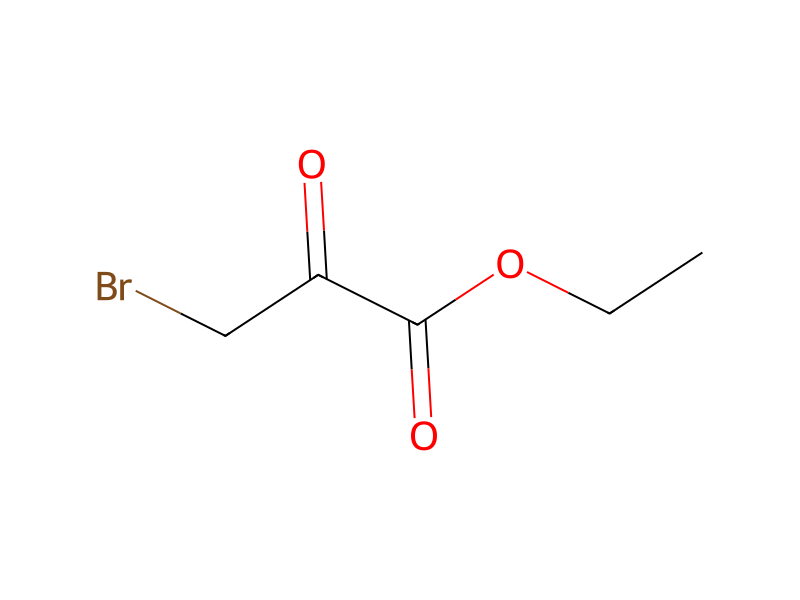
Ethyl bromopyruvate → HCID 12763962, compound
Reaction equation

Br[CH2:2][C:3](=O)[C:4]([O:6][CH2:7][CH3:8])=[O:5].[NH2:10][C:11]1[CH:20]=[C:19]([Cl:21])[C:18]2[C:13](=[CH:14][CH:15]=[CH:16][CH:17]=2)[N:12]=1>C(COC)OC>[Cl:21][C:19]1[C:18]2[C:13](=[CH:14][CH:15]=[CH:16][CH:17]=2)[N:12]2[CH:2]=[C:3]([C:4]([O:6][CH2:7][CH3:8])=[O:5])[N:10]=[C:11]2[CH:20]=1Participants
Reactant 2

Product 1

Reagents, catalysts & solvents 1

Procedure
4 g of ethyl bromopyruvate were added to a solution of 2 g of 2-amino-4-chloroquinoline [Hardman et al C.S., (1958), p. 614] in 40 ml of dimethoxyethane and the mixture obtained was allowed to stand at room temperature for 30 minutes. The quaternary salt thus precipitated was filtered off, washed with ether and then was dissolved in ethanol. The solution obtained was heated at reflux for 1 hour and then the ethanol was removed under vacuum. The residue was dissolved in chloroform and the solution was washed with dilute sodium carbonate solution and water, was decolorized with charcoal and the solvent was evaporated to leave a white solid. This solid was recrystallized from methanol to obtain fine white needles of ethyl 5-chloroimidazo-[1,2-a]-quinoline-2-carboxylate melting at 169°-170° C.
Workup
- customthe mixture obtained
- customThe quaternary salt thus precipitated
- filtrationwas filtered off
- washwashed with ether
- dissolutionwas dissolved in ethanol
- customThe solution obtained
- temperaturewas heated
- temperatureat reflux for 1 hour
- customthe ethanol was removed under vacuum
- dissolutionThe residue was dissolved in chloroform
- washthe solution was washed with dilute sodium carbonate solution and water
- customthe solvent was evaporated
- customto leave a white solid
- customThis solid was recrystallized from methanol
Sources & evidence
- ORD record
- ord-423d04a1e90040658dd7209ea387bded
- Source dataset
- uspto-grants-1981_07
- Patent number
- US04279912
Reaction notes
Loading…