1,2-Dibromoethane → HCID 838311, compound
Reaction equation

[CH3:1][C:2]1[CH:3]=[C:4]2[C:12](=[CH:13][CH:14]=1)[NH:11][C:10]1[C:9](=[O:15])[CH2:8][CH2:7][CH2:6][C:5]2=1.[Br:16][CH2:17][CH2:18]Br.[OH-].[Na+].C1(=O)C2C(C3C(N=2)=CC=CC=3)=CC=C1>S([O-])(O)(=O)=O.C([N+](CCCC)(CCCC)CCCC)CCC.O>[CH3:1][C:2]1[CH:3]=[C:4]2[C:12](=[CH:13][CH:14]=1)[N:11]([CH2:18][CH2:17][Br:16])[C:10]1[C:9](=[O:15])[CH2:8][CH2:7][CH2:6][C:5]2=1Participants



Procedure
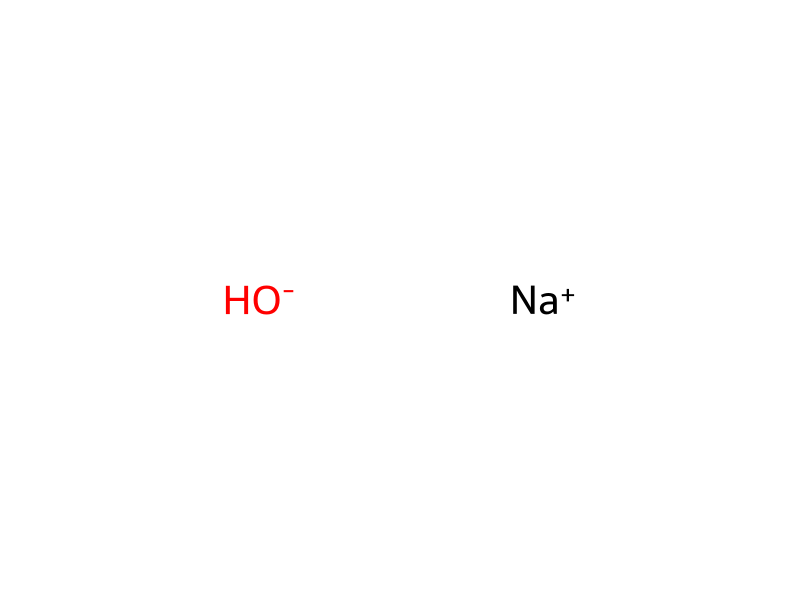
199 g. (1 mole) of 6-methyl-1,2,3,4-tetrahydrocarbazol-1-one (m.p.: 199° C., as given in literature: 194°-195° C., 195°-196° C., 195° C., cf. Bloink and Pausacker loc. cit. page 1330), 1520 g. (8.1 moles), 1,2-dibromoethane and 1000 ml. (7.5 moles) of aqueous sodium hydroxide solution (30% strength) are taken initially and admixed, while stirring at room temperature, with 4.25 g. (12.5 m mole) of tetrabutylammoniumhydrogensulfate dissolved in 25 ml of water. With a slight temperature rise, the reaction sets in and while continuously stirring, comes to an end after some seven hours' time. For working up, the aqueous alkaline layer is separated, the organic layer washed with water and the excess dibromoethane distilled off in vacuo. The residue is recrystallized from 200 ml. of ethanol. 281 g. (92% of the theoretical) of 6-methyl-9-(2-ethylbromide)-1,2,3,4-tetrahydrocarbazol-1-one (melting at 103° C.). The amount of the tetrabutylammoniumhydrogensulfate used as catalyst can be reduced to 5 m moles per 1 mole of the carbazolone employed, but the reaction takes twice as long when this change is made.
Workup
- stirringwhile continuously stirring
- customthe aqueous alkaline layer is separated
- washthe organic layer washed with water
- distillationthe excess dibromoethane distilled off in vacuo
- customThe residue is recrystallized from 200 ml
Sources & evidence
- ORD record
- ord-33562c8b56c04b2192f44077a9edea37
- Source dataset
- uspto-grants-1981_03
- Patent number
- US04258043
Reaction notes
Loading…