反应详情
EQUATION
反应方程式

REACTANTS
反应物

PRODUCTS
产物

AUXILIARIES
试剂、催化剂与溶剂
PROCEDURE
实验过程
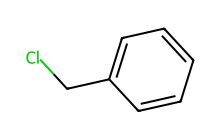
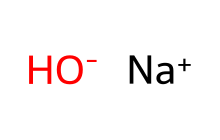
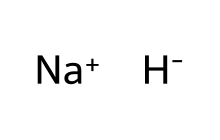
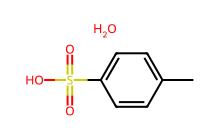
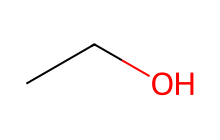
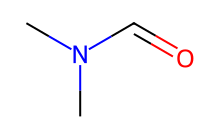
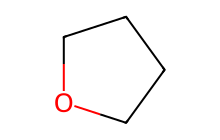
A 6.51 g (19.5 mmol) portion of crude 4-[1-benzyloxy-3-(isoamyloxycarbonyl)cyclobutan-3-yl]-2-pyrrolidone was dissolved in a mixed solvent consisting of 45 ml of dimethylformamide and 45 ml of tetrahydrofuran, and to the resulting solution which was cooled in an ice bath and stirred was subsequently added 935 mg (23.4 mmol) of 60% oily sodium hydride gradually. After 10 minutes of stirring, the reaction mixture was further stirred at room temperature for 1 hour and then, while cooling in an ice bath with stirring, 2.80 ml (23.4 mmol) of benzyl chloride was added dropwise thereto. After 1 hour of stirring, the resulting reaction solution was subjected to separation of layers at room temperature. The thus separated organic layer was washed with saturated brine and then dried over anhydrous sodium sulfate. After filtration, the solvent was evaporated under a reduced pressure to give an oily material. The oily material was dissolved in 100 ml of ethanol, 20 ml of 10 N sodium hydroxide aqueous solution was added dropwise to the resulting solution which was cooled and stirred in an ice bath, and then 14 hours of stirring was carried out at room temperature. After evaporation of ethanol under a reduced pressure, the thus obtained residue was mixed with 20 ml of water and then, while cooling in an ice bath, acidified with concentrated hydrochloric acid. After filtration, this was extracted with diethyl ether (100 ml×3) and then dried over anhydrous sodium sulfate. After filtration, this was concentrated under a reduced pressure, the thus obtained residue was dissolved in 180 ml of ethanol, and the resulting solution was gradually mixed with 4.55 g (23.9 mmol) of p-toluenesulfonic acid monohydrate and heated under reflux for 3 hours. The reaction solution was concentrated, mixed with saturated sodium bicarbonate aqueous solution and then extracted with chloroform, and the resulting organic layer was dried over anhydrous sodium sulfate. After filtration, the solvent was evaporated under a reduced pressure and the resulting residue was purified by a silica gel column chromatography (n-hexane:ethyl acetate=2:1) to give 2.20 g of the title compound as a diastereomer mixture. Thereafter, the thus obtained title compound was again subjected to a silica gel column chromatography (n-hexane:ethyl acetate=4:1) to separate the diastereoisomers into 0.76 g of Isomer A and 1.44 g of Isomer B. and the following reaction was carried out using the Isomer A.
WORKUP
后处理
- temperatureto the resulting solution which was cooled in an ice bath
- stirringAfter 10 minutes of stirring
- stirringthe reaction mixture was further stirred at room temperature for 1 hour
- temperaturewhile cooling in an ice bath
- stirringwith stirring
- stirringAfter 1 hour of stirring
- customthe resulting reaction solution
- customwas subjected to separation of layers at room temperature
- washThe thus separated organic layer was washed with saturated brine
- dry with materialdried over anhydrous sodium sulfate
- filtrationAfter filtration
- customthe solvent was evaporated under a reduced pressure
- customto give an oily material
- temperaturewas cooled
- stirringstirred in an ice bath
- stirring14 hours of stirring
- customwas carried out at room temperature
- customAfter evaporation of ethanol under a reduced pressure
- additionthe thus obtained residue was mixed with 20 ml of water
- temperaturewhile cooling in an ice bath
- filtrationAfter filtration
- extractionthis was extracted with diethyl ether (100 ml×3)
- dry with materialdried over anhydrous sodium sulfate
- filtrationAfter filtration
- concentrationthis was concentrated under a reduced pressure
- dissolutionthe thus obtained residue was dissolved in 180 ml of ethanol
- temperatureheated
- temperatureunder reflux for 3 hours
- concentrationThe reaction solution was concentrated
- additionmixed with saturated sodium bicarbonate aqueous solution
- extractionextracted with chloroform
- dry with materialthe resulting organic layer was dried over anhydrous sodium sulfate
- filtrationAfter filtration
- customthe solvent was evaporated under a reduced pressure
- customthe resulting residue was purified by a silica gel column chromatography (n-hexane:ethyl acetate=2:1)