Quinone → 5,6-Dichloro-2-(4-formylphenyl)benzimidazole
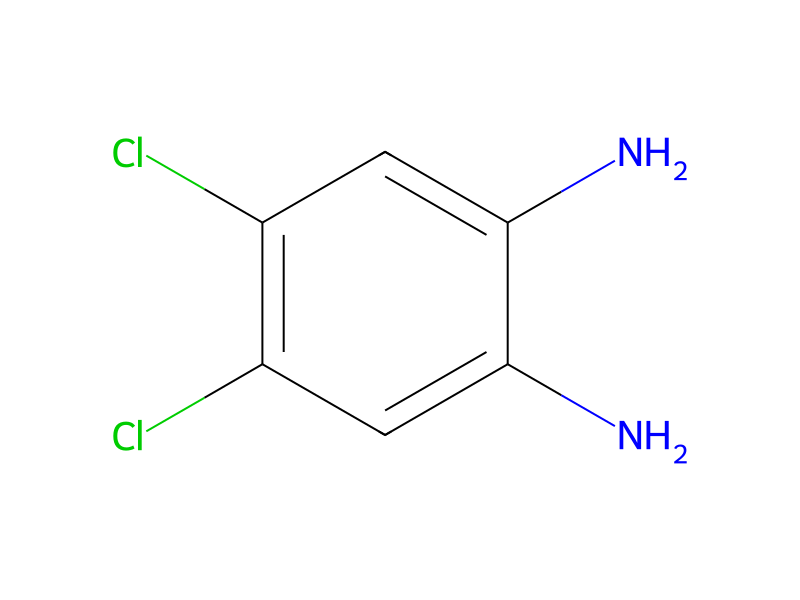
Reaction equation

CCO[CH:4]([O:13]CC)[C:5]1[CH:10]=[CH:9][C:8]([CH:11]=O)=[CH:7][CH:6]=1.[Cl:16][C:17]1[C:22]([Cl:23])=[CH:21][C:20]([NH2:24])=[C:19]([NH2:25])[CH:18]=1.C1(=O)C=CC(=O)C=C1>C(O)C>[Cl:16][C:17]1[C:22]([Cl:23])=[CH:21][C:20]2[N:24]=[C:11]([C:8]3[CH:7]=[CH:6][C:5]([CH:4]=[O:13])=[CH:10][CH:9]=3)[NH:25][C:19]=2[CH:18]=1Participants
5
Reactant 3


Product 1

Reagents, catalysts & solvents 1

Procedure
To a mixture of terephthalaldehyde mono-(diethyl acetal) (2.0 mL, 10 mmol), 4,5-dichloro-1,2-phenylenediamine (1.77 g, 10 mmol) and 1,4-benzoquinone (1.08 g, 10 mmol) in ethanol (50 mL) was heated to reflux for 6 h. The solvent was removed under reduced pressure. To the residue were added tetrahydrofuran (50 mL) and hydrochloric acid (1 mol/L, 10 mL), and the mixture was stirred at room temperature for 2 h. Water was added, and the mixture was extracted with ethyl acetate. The organic layer was washed with water and brine, and dried on anhydrous sodium sulfate. The solvent was removed under reduced pressure, and the residue was triturated with ether to afford 5,6-dichloro-2-(4-formylphenyl)benzimidazole (2.80 g, 97%).
Workup
- temperaturewas heated
- temperatureto reflux for 6 h
- customThe solvent was removed under reduced pressure
- additionTo the residue were added tetrahydrofuran (50 mL) and hydrochloric acid (1 mol/L, 10 mL)
- additionWater was added
- extractionthe mixture was extracted with ethyl acetate
- washThe organic layer was washed with water and brine
- dry with materialdried on anhydrous sodium sulfate
- customThe solvent was removed under reduced pressure
- customthe residue was triturated with ether
Sources & evidence
- ORD record
- ord-22cd26916360454f93852f42d36cb995
- Source dataset
- uspto-grants-2002_09
- Patent number
- US06452014B1
Reaction notes
Loading…