Acrylonitrile → HCID 12361859, compound
Reaction equation

CN(C)C1CC2C3C(=CC=CC=3)NC=2CC1.C(#N)C=C.[OH-].C([N+](C)(C)C)C1C=CC=CC=1.CN(C)C1CC2C3C(=CC=CC=3)N(CCC#N)C=2CC1.[OH-].[K+].Cl.[CH3:56][N:57]([CH3:76])[CH:58]1[CH2:70][C:69]2[C:68]3[C:63](=[CH:64][CH:65]=[CH:66][CH:67]=3)[N:62]([CH2:71][CH2:72][C:73]([OH:75])=[O:74])[C:61]=2[CH2:60][CH2:59]1>CO.C(O)C.C1C=CC=CC=1>[CH3:76][N:57]([CH3:56])[CH:58]1[CH2:70][C:69]2[C:68]3[C:63](=[CH:64][CH:65]=[CH:66][CH:67]=3)[N:62]([CH2:71][CH2:72][C:73]([OH:75])=[O:74])[C:61]=2[CH2:60][CH2:59]1Participants
Reactant 6





Product 1

Reagents, catalysts & solvents 3



Procedure
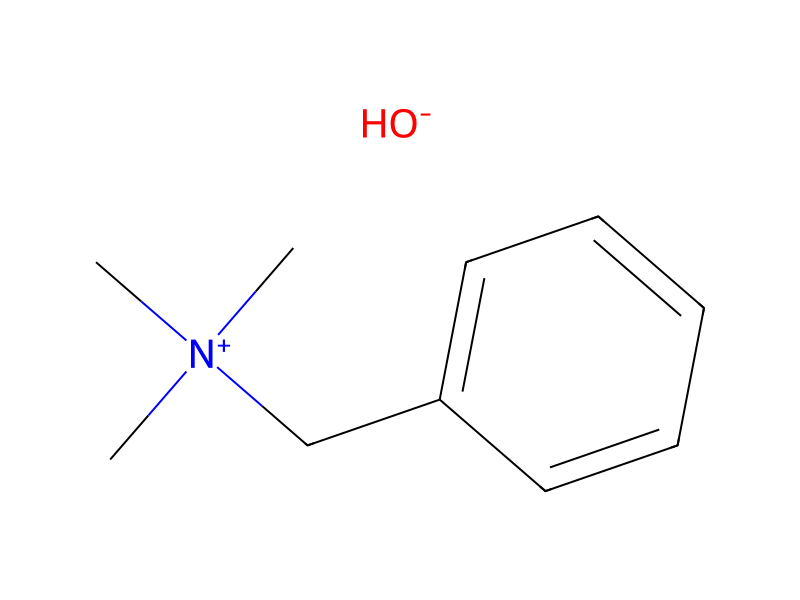
To a solution of 17.1 g. of 3-(dimethylamino)-1,2,3,4-tetrahydrocarbazole in 150 ml. of benzene was added 10.6 g. of acrylonitrile followed by 1 ml. of 35% benzyltrimethylammonium hydroxide in methyl alcohol. The solution was heated under reflux for one hour and fifteen minutes, cooled to room temperature, filtered, and evaporated to dryness. The residue was treated with hot hexane and then hot heptane (total volume 3.3 liters), both solutions being decanted from insoluble gum. The combined hexane-heptane solution was cooled and filtered to give a solid which, on recrystallization from hexane, yielded 8.6 g. of 3-(dimethylamino)-9-(2-cyanoethyl)-1,2,3,4-tetrahydrocarbazole, m.p. 106°-108° C. A solution of 13 g. of 3-(dimethylamino)-9-(2-cyanoethyl)-1,2,3,4-tetrahydrocarbazole in 125 ml. of ethyl alcohol and 150 ml. of 10% potassium hydroxide solution was heated under reflux for three hours, cooled, and the ethyl alcohol was removed under reduced pressure. The resulting aqueous solution was extracted with benzene, and the aqueous layer was separated and treated with acid to pH 7, cooled, and filtered to give 5.6 g. of solid material. The filtrate was acidified to pH 6 and the resulting crystals were collected by filtration. The filtrate was evaporated to dryness under reduced pressure and the solid residue was slurried in water and collected by filtration. The above three crops of solids were combined, dissolved in ethyl alcohol and treated with hydrogen chloride in ethyl alcohol to give, on filtration and recrystallization from ethyl alcohol, 11.4 g. of 3-(dimethylamino)-1,2,3,4-tetrahydrocarbazole-9-propionic acid hydrochloride, m.p. 304°-305° C.
Workup
- temperatureThe solution was heated
- temperatureunder reflux for one hour and fifteen minutes
- filtrationfiltered
- customevaporated to dryness
- additionThe residue was treated with hot hexane
- customhot heptane (total volume 3.3 liters), both solutions being decanted from insoluble gum
- temperatureThe combined hexane-heptane solution was cooled
- filtrationfiltered
- customto give a solid which
- customon recrystallization from hexane
- customyielded 8.6 g
- temperatureunder reflux for three hours
- temperaturecooled
- customthe ethyl alcohol was removed under reduced pressure
- extractionThe resulting aqueous solution was extracted with benzene
- customthe aqueous layer was separated
- additiontreated with acid to pH 7
- temperaturecooled
- filtrationfiltered
- customto give 5.6 g
- filtrationthe resulting crystals were collected by filtration
- customThe filtrate was evaporated to dryness under reduced pressure
- filtrationcollected by filtration
- dissolutiondissolved in ethyl alcohol
- additiontreated with hydrogen chloride in ethyl alcohol
- customto give, on filtration and recrystallization from ethyl alcohol, 11.4 g
Sources & evidence
- ORD record
- ord-7c6f7bc81d754cfb9afc18c89275c73f
- Source dataset
- uspto-grants-1981_03
- Patent number
- US04257952
Reaction notes
Loading…