1,1-Diphenylethylene → 2-Bromo-1,1-diphenylethylene
Reaction equation

[C:1]1([C:7]([C:9]2[CH:14]=[CH:13][CH:12]=[CH:11][CH:10]=2)=[CH2:8])[CH:6]=[CH:5][CH:4]=[CH:3][CH:2]=1.[Br:15]Br>C(Cl)(Cl)(Cl)Cl>[Br:15][CH:8]=[C:7]([C:9]1[CH:10]=[CH:11][CH:12]=[CH:13][CH:14]=1)[C:1]1[CH:6]=[CH:5][CH:4]=[CH:3][CH:2]=1Participants
Reactant 2
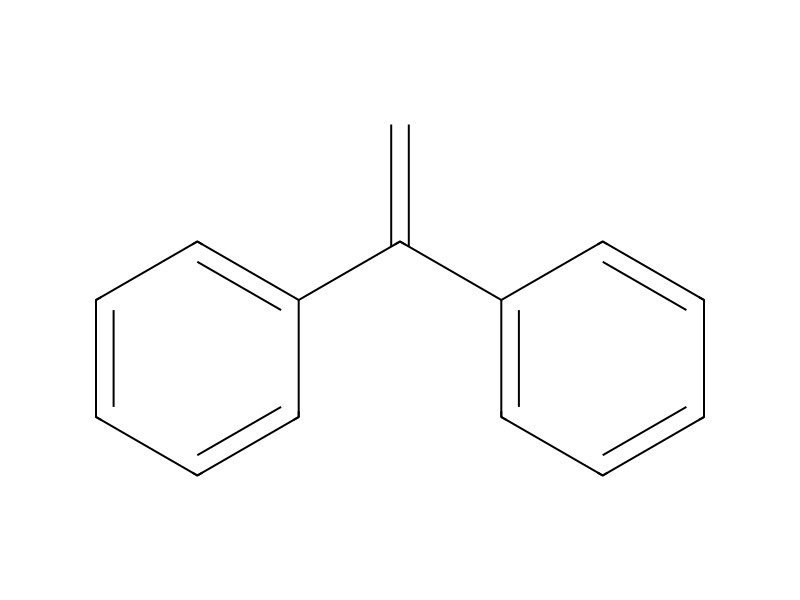

Product 1

Reagents, catalysts & solvents 1

Procedure
Into a reactor were introduced 110 g (0.60 mol) of the 1,1-diphenylethylene and 1,098 g of carbon tetrachloride under a nitrogen atmosphere. A solution prepared by mixing 95.9 g (0.60 mol) of bromine with 288 g of carbon tetrachloride was added dropwise thereto over 1 hour with cooling with ice. After completion of the addition, the reaction mixture was stirred at that temperature for 7 hours and then concentrated. To the residue were added 119 g of pyridine and 500 mL of toluene. This mixture was refluxed for 3 hours. After being cooled, the reaction mixture was washed with 5% hydrochloric acid and water, subsequently dried with anhydrous sodium sulfate, and then concentrated under reduced pressure. The resultant concentrate was distilled and then recrystallized from methanol to obtain 126 g (81%) of the target compound as white crystals.
Workup
- customA solution prepared
- additionwas added dropwise
- temperatureover 1 hour with cooling with ice
- additionAfter completion of the addition
- concentrationconcentrated
- additionTo the residue were added 119 g of pyridine and 500 mL of toluene
- temperatureThis mixture was refluxed for 3 hours
- temperatureAfter being cooled
- washthe reaction mixture was washed with 5% hydrochloric acid and water
- dry with materialsubsequently dried with anhydrous sodium sulfate
- concentrationconcentrated under reduced pressure
- concentrationThe resultant concentrate
- distillationwas distilled
- customrecrystallized from methanol
Sources & evidence
- ORD record
- ord-0a9b09ff78fb41cdb06e05ac98eadb52
- Source dataset
- uspto-grants-2002_09
- Patent number
- US06455720B1
Reaction notes
Loading…