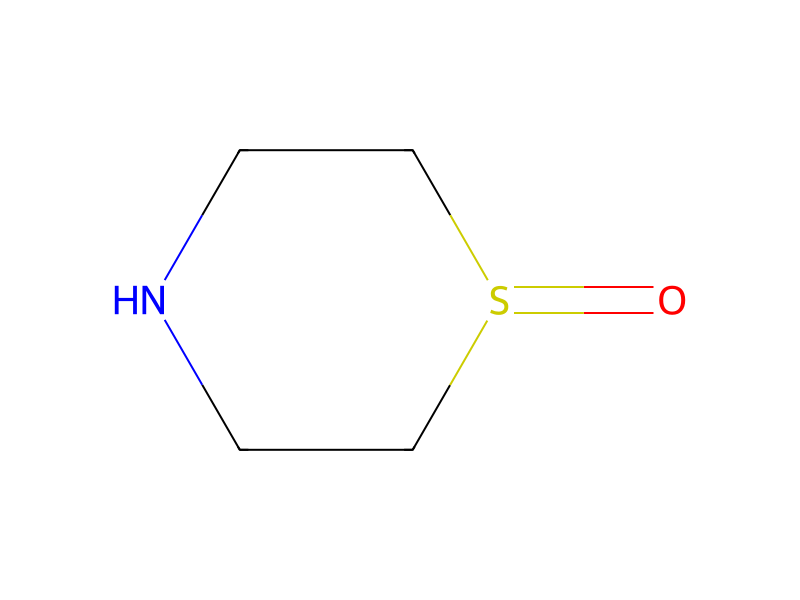
Thiomorpholine 1-oxide → HCID 53709073, compound
Reaction equation

[C:1]([C:3]1[N:8]=[C:7]([Cl:9])[N:6]=[C:5](Cl)[C:4]=1[Cl:11])#[N:2].[NH:12]1[CH2:17][CH2:16][S:15](=[O:18])[CH2:14][CH2:13]1>>[C:1]([C:3]1[N:8]=[C:7]([Cl:9])[N:6]=[C:5]([N:12]2[CH2:17][CH2:16][S:15](=[O:18])[CH2:14][CH2:13]2)[C:4]=1[Cl:11])#[N:2]Participants
3


Procedure
5.8 gm (0.02 mol) of 6-cyano-2,5-dichloro-4-(1-oxido-thiomorpholino)-pyrimidine (m.p. 145°-147°C), obtained from 6-cyano-2,4,5-trichloro-pyrimidine and thiomorpholine-1-oxide, were slowly added to a solution of 19.4 gm (0.1 mol) of piperazine hexahydrate in 100 ml of dioxane, whereby a mild endothermic reaction was released and a solution was rapidly formed. After standing for a short time, the reaction mixture was evaporated almost to dryness in vacuo, and the residue was taken up in about 100 ml of water. The reaction product, which separated out as pale yellow precipitate, was suction-filtered off, washed with water and dried. Yield: 6.4 gm (94% of theory); m.p. 203°-205°C.
Sources & evidence
- ORD record
- ord-25706fb3c71349a78c0d1e6b0c1a1cda
- Source dataset
- uspto-grants-1976_08
- Patent number
- US03975384
Reaction notes
Loading…