Water → HCID 13336902, compound
Reaction equation

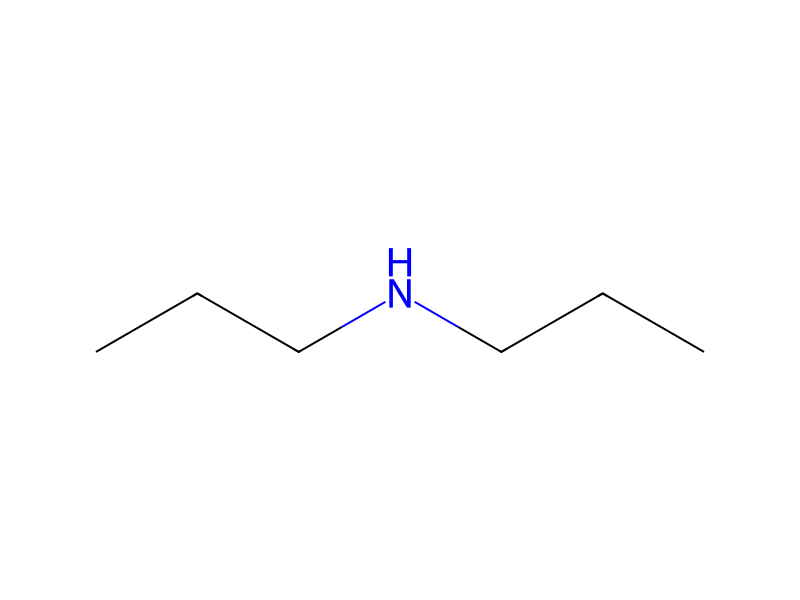
[C:1]([C:3]1[C:8]([C:9]#[N:10])=[N:7][C:6](Cl)=[C:5]([CH2:12][CH3:13])[N:4]=1)#[N:2].[CH2:14]([NH:17][CH2:18][CH2:19][CH3:20])[CH2:15][CH3:16].O>CC(C)=O>[C:1]([C:3]1[C:8]([C:9]#[N:10])=[N:7][C:6]([N:17]([CH2:18][CH2:19][CH3:20])[CH2:14][CH2:15][CH3:16])=[C:5]([CH2:12][CH3:13])[N:4]=1)#[N:2]Participants
5
Reactant 3


Product 1

Reagents, catalysts & solvents 1

Procedure
2,3-Dicyano-5-chloro-6-ethylpyrazine (1.92 g; 0.01 mole) was dissolved in 30 ml of acetone. The solution was cooled to 0° to 5° C., and with stirring, 2.02 g (0.02 mole) of di-n-propylamine was added dropwise. The mixture was stirred for 30 minutes. The precipitate was separated by filtration. The filtrate was concentrated under reduced pressure to afford a yellow oily product. Water (20 ml) was added to the oily product, and the precipitated white powder was recrystallized from ethanol to afford 1.28 g (yield 50%) of 2,3-dicyano-5-di-n-propylamino-6-ethylpyrazine.
Workup
- temperatureThe solution was cooled to 0° to 5° C.
- stirringThe mixture was stirred for 30 minutes
- customThe precipitate was separated by filtration
- concentrationThe filtrate was concentrated under reduced pressure
- customto afford a yellow oily product
- customthe precipitated white powder was recrystallized from ethanol
Sources & evidence
- ORD record
- ord-4e19cbcd52f644bc8a211320478bf3bc
- Source dataset
- uspto-grants-1981_03
- Patent number
- US04259489
Reaction notes
Loading…