2-Aminophenol → 2-(2H-Benzotriazole-2-yl)phenol
Reaction equation

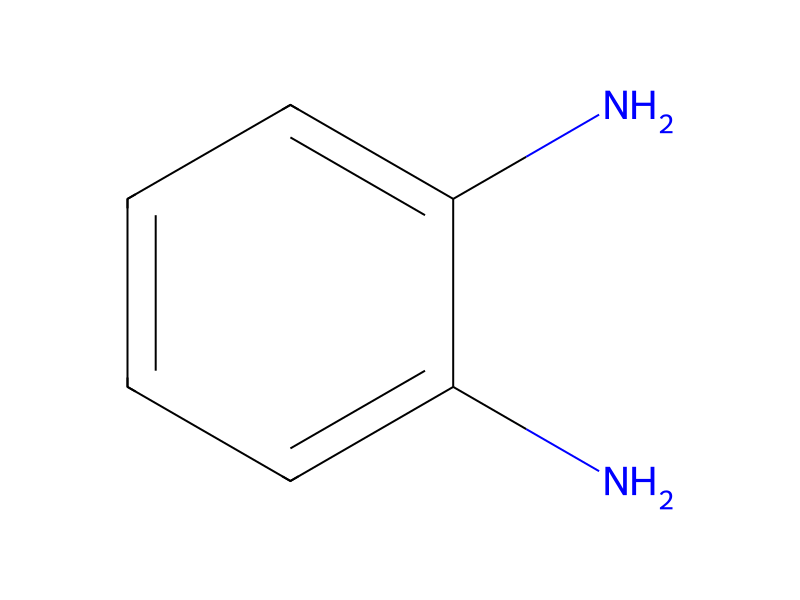
[H][H].N[C:4]1[CH:19]=[CH:18][C:7]2=[N:8][N:9]([C:11]3[CH:16]=[CH:15][CH:14]=[CH:13][C:12]=3[OH:17])[N:10]=[C:6]2[CH:5]=1.[N+](C1C=CC(O)=C(N=NC2C=CC=CC=2O)C=1C1C=CC=CC=1)([O-])=O.C1(N)C=CC=CC=1N.NC1C=CC=CC=1O>>[OH:17][C:12]1[CH:13]=[CH:14][CH:15]=[CH:16][C:11]=1[N:9]1[N:10]=[C:6]2[CH:5]=[CH:4][CH:19]=[CH:18][C:7]2=[N:8]1Participants





Procedure
2-(2'-Hydroxyphenyl)benzotriazoles are known as light stabilizers for plastics (U.S. Pat. No. 3,004,896, Heller et al., Oct. 17, 1961). One method of making these compounds involves reducing an azo compound with powdered zinc (U.S. Pat. No. 3,214,436, Boyle et al., Oct. 26, 1965) but this method presents a problem of separation of large amounts of zinc oxide from the product. Another method involves oxidizing a diaminohydroxyazobenzene to form a 5-amino-2-(2'-hydroxyphenyl)benzotriazole which must then be subjected to an undesirable diazotization step. It would be desirable to use the cheapest and most convenient reducing agent, hydrogen gas, but, unfortunately, instead of the desired benzotriazole, the usual products of catalytic hydrogenation of a nitrophenylazophenol are the corresponding o-phenylenediamine and o-aminophenol in nearly quantitative yield [W. F. Whitmore and A. J. Revukus, J. Am. Chem. Soc., 62, 1687 (1940)]. The present invention is based on the surprising discovery that in an alkaline medium, the catalytic hydrogenation does not produce the previously observed cleavage of azobenzene N=N bond but instead yields the desired 2-(hydroxyphenyl)benzotriazole.
Workup
- customthe catalytic hydrogenation does not produce the previously observed cleavage of azobenzene N=N bond
Sources & evidence
- ORD record
- ord-6d073d21191b43a4ad28fc43da14590f
- Source dataset
- uspto-grants-1976_08
- Patent number
- US03978074
Reaction notes
Loading…