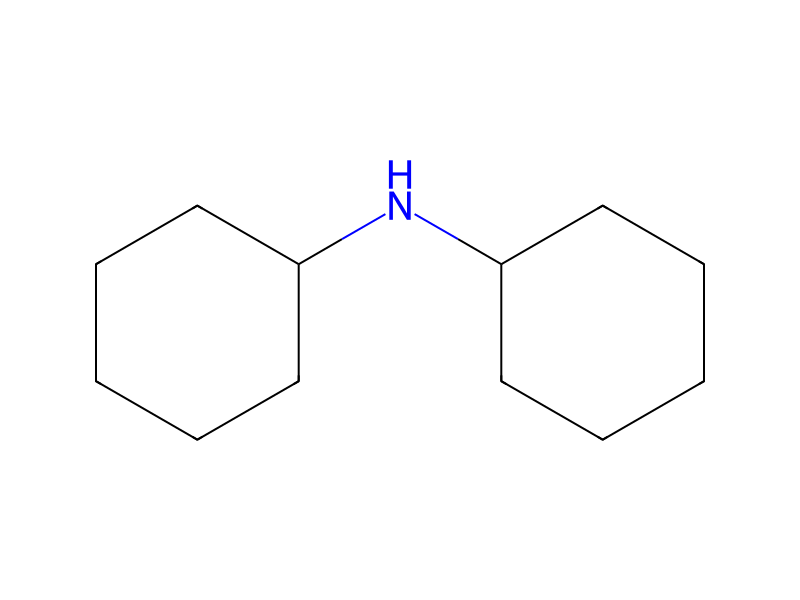
Dicyclohexylamine → 1H-Isoindole-1,3(2H)-dione, 2-(4-chloro-2-fluoro-5-(1-methylethoxy)phenyl)-4,5,6,7-tetrahydro-
Reaction equation

[F:1][C:2]1[CH:7]=[CH:6][C:5]([O:8][CH:9]([CH3:11])[CH3:10])=[CH:4][C:3]=1[N:12]1[C:16](=[O:17])[C:15]2[CH2:18][CH2:19][CH2:20][CH2:21][C:14]=2[C:13]1=[O:22].C1(NC2CCCCC2)CCCCC1.[Cl:36]Cl>ClC(Cl)=C(Cl)Cl>[Cl:36][C:6]1[C:5]([O:8][CH:9]([CH3:11])[CH3:10])=[CH:4][C:3]([N:12]2[C:13](=[O:22])[C:14]3[CH2:21][CH2:20][CH2:19][CH2:18][C:15]=3[C:16]2=[O:17])=[C:2]([F:1])[CH:7]=1Participants
5
Reactant 3


Product 1

Reagents, catalysts & solvents 1

Procedure
N-(2-Fluoro-5-isopropoxyphenyl)-3,4,5,6-tetrahydrophthalimide (II: R=isopropyl) (1 g) and dicyclohexylamine (0.01 g) were dissolved in tetrachloroethylene (20 ml), and chlorine (1 ml) was introduced therein at room temperature. The resultant solution was stirred at the room temperature for 2 hours. The reaction mixture was extracted with methylene chloride, and the extract was concentrated. The residue was purified by silica gel chromatography using a mixture of n-hexane and ethyl acetate as an eluent to give 0.9 g of N-(4-chloro-2-fluoro-5-isopropoxyphenyl)-3,4,5,6-tetrahydrophthalimide (I: R=isopropyl). M.P., 81°-82° C.
Workup
- customat room temperature
- extractionThe reaction mixture was extracted with methylene chloride
- concentrationthe extract was concentrated
- customThe residue was purified by silica gel chromatography
- additiona mixture of n-hexane and ethyl acetate as an eluent
Sources & evidence
- ORD record
- ord-894856193b0b4e4591cd2b42f6d0931c
- Source dataset
- uspto-grants-1986_01
- Patent number
- US04563535
Reaction notes
Loading…