Sodium Hydroxide → Sulfometuron
Reaction equation

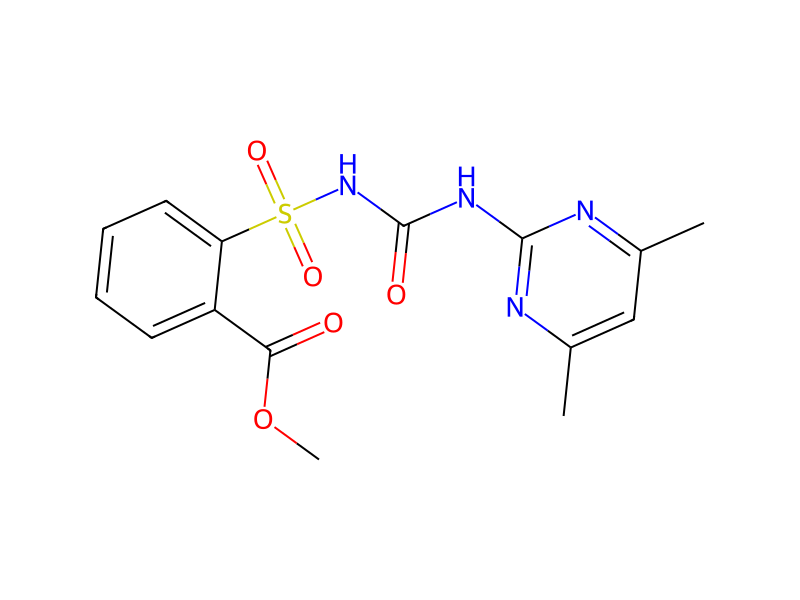
[CH3:1][C:2]1[CH:7]=[C:6]([CH3:8])[N:5]=[C:4]([NH:9][C:10]([NH:12][S:13]([C:16]2[CH:21]=[CH:20][CH:19]=[CH:18][C:17]=2[C:22]([O:24]C)=[O:23])(=[O:15])=[O:14])=[O:11])[N:3]=1.[OH-].[Na+]>O>[CH3:1][C:2]1[CH:7]=[C:6]([CH3:8])[N:5]=[C:4]([NH:9][C:10]([NH:12][S:13]([C:16]2[CH:21]=[CH:20][CH:19]=[CH:18][C:17]=2[C:22]([OH:24])=[O:23])(=[O:15])=[O:14])=[O:11])[N:3]=1Participants


Reagents, catalysts & solvents 1

Procedure
A mixture of 2.0 g of N-[(4,6-dimethylpyrimidin-2-yl)aminocarbonyl]-2-methoxycarbonylbenzenesulfonamide and 11 ml. of 50% aqueous sodium hydroxide was warmed on a steam bath with shaking; 40 ml. of water was added and heating and shaking continued during the next half hour. The resulting solution was then filtered and the filtrate acidified with hydrochloric acid to pH 2 to yield a precipitate which was isolated by filtration to yield the title compound, 0.7 g melting at 160° with decomposition. The nuclear magnetic resonance spectrum showed resonance peaks for the methyl substituents on the pyrimidine ring at 2.66 ppm and the ring hydrogens at 7.2 to 8.4 ppm. The disappearance of the resonance peak at 4.0 ppm confirmed the conversion of the methyl ester to the carboxy group.
Workup
- temperatureheating
- stirringshaking
- customcontinued during the next half hour
- filtrationThe resulting solution was then filtered
- customto yield a precipitate which
- customwas isolated by filtration
Sources & evidence
- ORD record
- ord-c655c970f7f34f3c8da732629cb7675b
- Source dataset
- uspto-grants-1986_01
- Patent number
- US04564384
Reaction notes
Loading…