Ethyl 2-methyl-4-pentenoate → Ethyl 2-methylpentanoate
Reaction equation

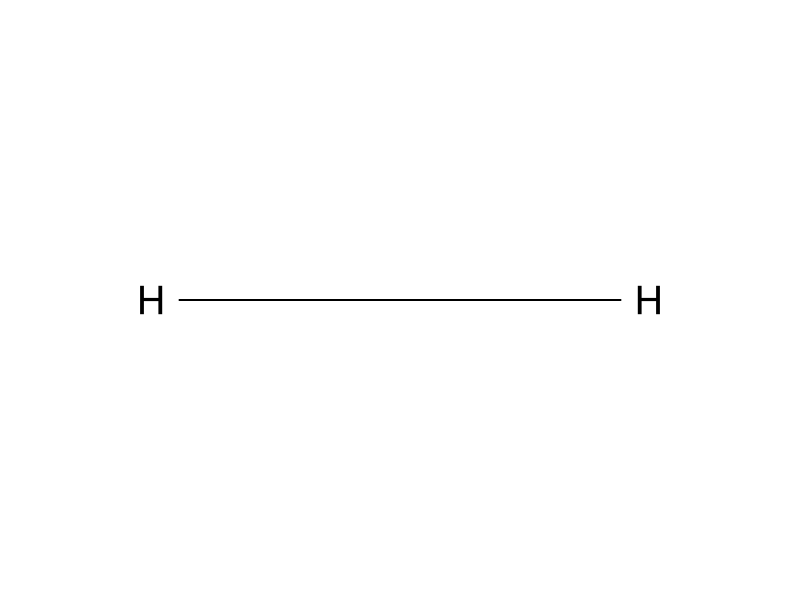
[CH2:1]([O:3][C:4](=[O:10])[CH:5]([CH3:9])[CH:6]=[C:7]=[CH2:8])[CH3:2].[H][H].C(OC(=O)C(C)/C=C\C)C.C(OC(=O)C(C)CC=C)C>[Pd].[Pd].CC([O-])=O.CC([O-])=O.[Pb+2].C(O)C>[CH2:1]([O:3][C:4](=[O:10])[CH:5]([CH3:9])[CH2:6][CH2:7][CH3:8])[CH3:2]Participants
Reactant 4


Product 1

Reagents, catalysts & solvents 3
Procedure
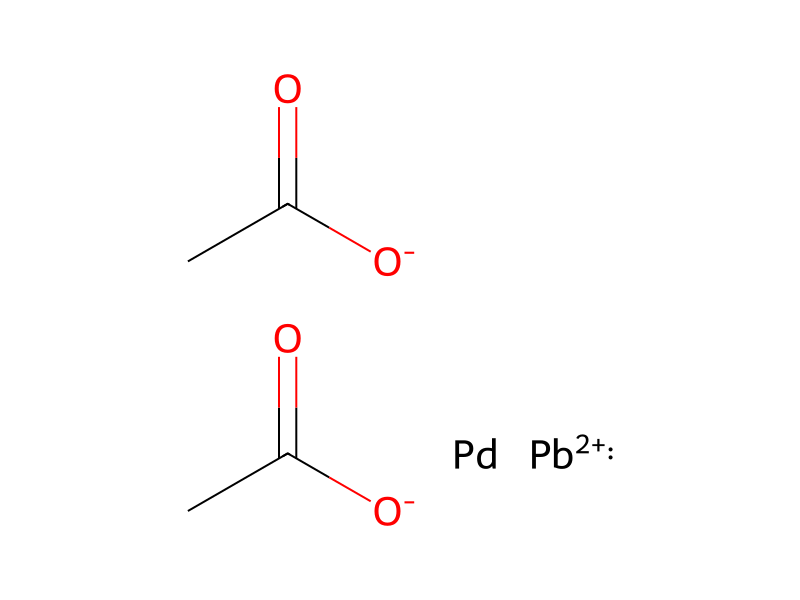
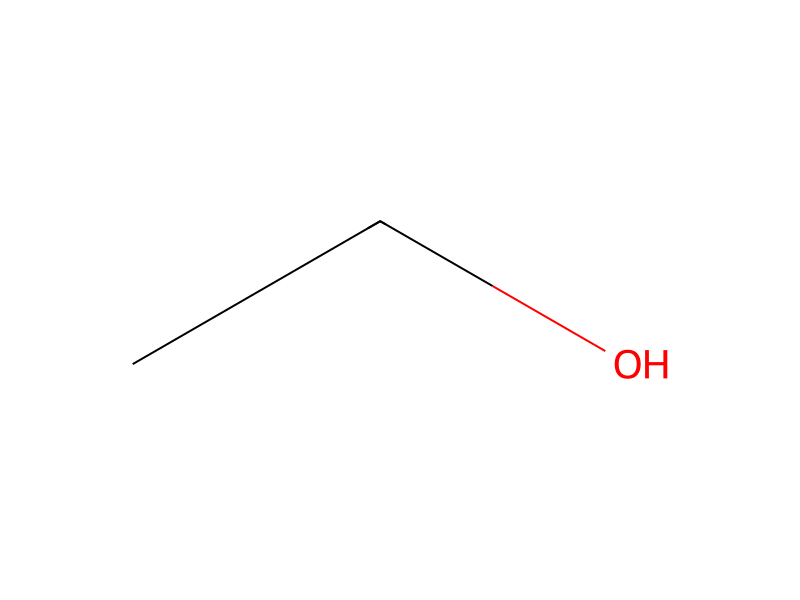
The resulting ethyl-2-methyl-3,4-pentadienoate is then reacted with hydrogen in the presence of a palladium-on-carbon catalyst or a "Lindlar" catalyst (palladium-on-calcium carbonate). The percentage of palladium on carbon or on calcium carbonate varies from about 2% up to about 7% with a percentage of palladium-on-carbon or on calcium carbonate being preferred to be about 5%. The temperature of reaction for this hydrogenation may vary from about 10° C up to about 50° C with a preferred reaction temperature of 25°-35° C. Since the reaction is exothermic, it is usually necessary to provide external cooling to the reaction mass during the course of the reaction. The pressure of hydrogen over the reaction mass may vary from about 5 psig up to about 50 psig, with the most preferred pressure being 20 psig. It has been found that pressures above 20 psig give rise to larger amounts of undesired side products. The hydrogenation reaction may be carried out in the presence of or in the absence of a solvent. When a solvent is used, it is required that it be an inert (non-reactive) solvent such as ethanol. If a solvent is used, it is preferred that the mole ratio of solvent:pentadienoate ester be approximately 1:1. The percentage of catalyst in the reaction mass may vary from 0.125% up to about 2.0% with a percentage of catalyst of about 0.25% being preferred. When using a Lindlar catalyst, the hydrogenation reaction produces a mixture of ethyl-2 -methyl-cis-3-pentenoate and ethyl-2-methyl-4-pentenoate in the ratio of from about 6:4 up to about 7:3. As a result, the desired ethyl-2-methyl-4-pentenoate for use in the instant invention may, if desired, be enriched with respect to the ethyl-2-methyl-4-pentenoate by means of fractional distillation or the mixture resulting may be used as such for its organoleptic properties as a tobacco flavor adjuvant or enhancer. Where the catalyst used is palladium-on-carbon rather than a Lindlar catalyst (palladium-on-calcium carbonate), a mixture of ethyl-2-methyl-cis-3-pentenoate, ethyl-2-methyl-4-pentenoate and ethyl-2-methyl-pentanoate is formed which may be used as such for its organoleptic properties as a tobacco flavor adjuvant or enhancer or which may be separated as by means of fractional distillation. In any event, at the end of the hydrogenation reaction, the reaction mass is filtered in order to separate catalyst from liquid phase desired product, and the filtrate is distilled using a fractional distillation column operated under vacuum.
Workup
- customThe temperature of reaction for this hydrogenation
- custommay vary from about 10° C up to about 50° C with a preferred reaction temperature of 25°-35° C
- customto provide external
- temperaturecooling to the reaction mass during the course of the reaction
- customgive rise to larger amounts of undesired side products
- customThe hydrogenation reaction
- customthe hydrogenation reaction
- customproduces
- distillationbe enriched with respect to the ethyl-2-methyl-4-pentenoate by means of fractional distillation
- customthe mixture resulting may
Sources & evidence
- ORD record
- ord-e914a5de80314800b3af66709ad821b0
- Source dataset
- uspto-grants-1976_10
- Patent number
- US03987803
Reaction notes
Loading…