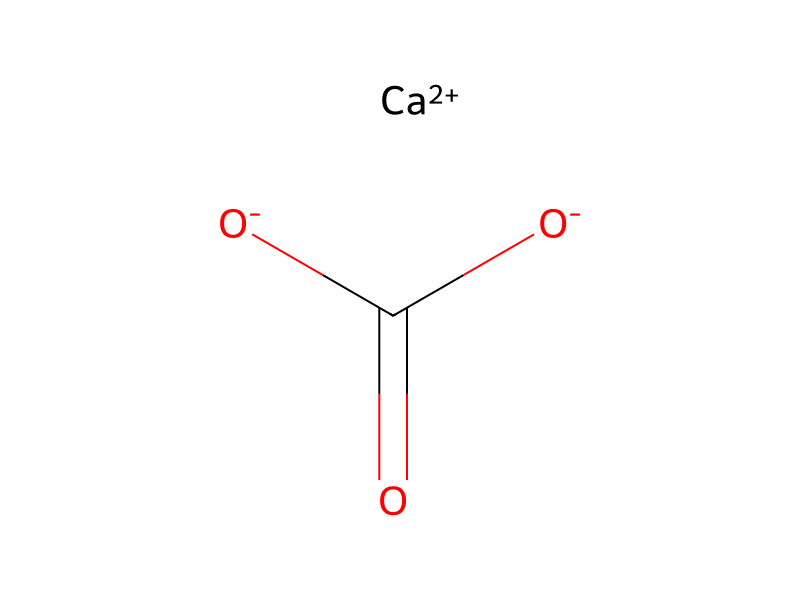
Calcium Carbonate → HCID 21502243, compound
Reaction equation

N[C:2]1[C:11]([Cl:12])=[C:10]2[C:5]([CH:6]=[CH:7][N:8]=[CH:9]2)=[CH:4][CH:3]=1.[N:13]([O-:15])=[O:14].[Na+].N(O)=O.C(=O)([O-])[O-].[Ca+2]>S(=O)(=O)(O)O.O>[Cl:12][C:11]1[C:2]([N+:13]([O-:15])=[O:14])=[CH:3][CH:4]=[C:5]2[C:10]=1[CH:9]=[N:8][CH:7]=[CH:6]2Participants
Reactant 4



Product 1

Reagents, catalysts & solvents 2


Conditions
- Temperature
- 50 °C
Procedure
7-Amino-8-chloroisoquinoline (0.05 mole) in dilute aqueous sulfuric acid at 3° C. is treated with sodium nitrite (0.05 mole). After 30 minutes, the reaction mixture is tested for nitrous acid with starch/iodide paper as described in Example 15. When a positive reaction is obtained, the mixture is neutralized with aqueous calcium carbonate solution and added with stirring to a hot solution (50° C.) of 50 g. of sodium nitrite, 5 g. of cupric sulfate pentahydrate and 50 ml. of water containing 3 g. of cuprous oxide in suspension. The reaction mixture is heated to 70° C. for 10 minutes and then extracted with ether. The extract is evaporated to give 8-chloro-7-nitroisoquinoline. The product is purified by chromatography on silica gel, eluting with ether followed by recrystallization from methanol.
Workup
- customWhen a positive reaction
- customis obtained
- additionadded
- temperatureThe reaction mixture is heated to 70° C. for 10 minutes
- extractionextracted with ether
- customThe extract is evaporated
Sources & evidence
- ORD record
- ord-6e2b826d0c6a4e20a23e249663a98888
- Source dataset
- uspto-grants-1976_10
- Patent number
- US03988339
Reaction notes
Loading…