HuagongsheHuagongshe Chemistry Print Report · For research reference only
HRID 13238Generated: October 25, 2026
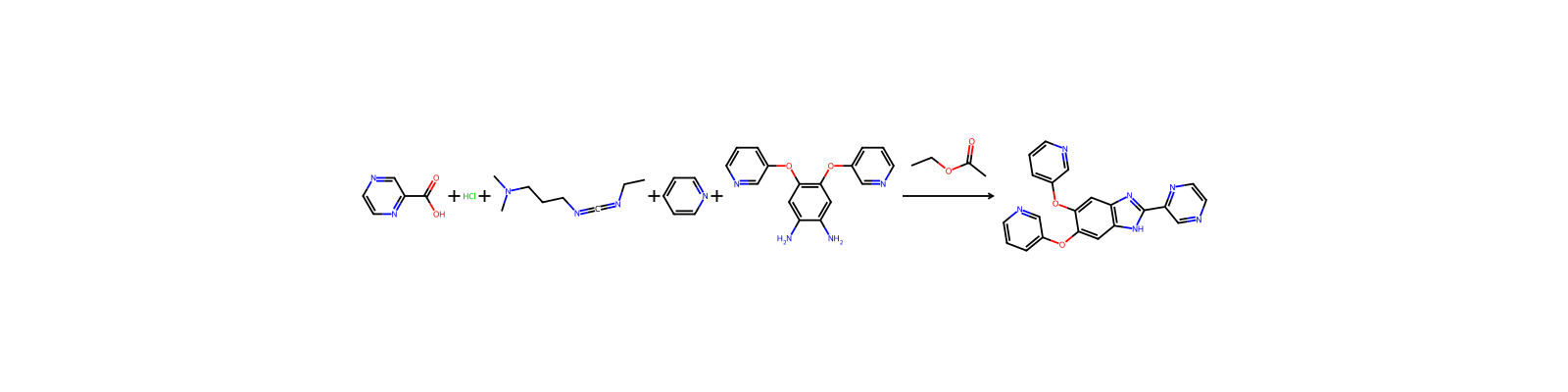
2-Pyrazinecarboxylic acid → 2-pyrazin-2-yl-5,6-bis(pyridin-3-yloxy)-1H-benzimidazole
https://huagongshe.com/reaction/13238
Participants
| Role | Name | HCID | Charge |
|---|
| Reactant | 2-Pyrazinecarboxylic acid | HCID 1047 | — |
| Reactant | Pyridine | HCID 1049 | — |
| Reactant | 1,3-Propanediamine, N'-(ethylcarbonimidoyl)-N,N-dimethyl-, monohydrochloride | HCID 2723939 | — |
| Reactant | 4,5-Bis(pyridin-3-yloxy)-benzene-1,2-diamine | HCID 23145472 | — |
| Solvent | Ethyl Acetate | HCID 8857 | — |
| Product | 2-pyrazin-2-yl-5,6-bis(pyridin-3-yloxy)-1H-benzimidazole | HCID 23145176 | — |
Reaction Steps
7.7 mg of pyrazine-2-carboxylic acid and 20 mg of 1-(3-dimethylaminopropyl)-3-ethylcarbodiimide monohydrochloride were added to a pyridine (1 ml) solution of 15 mg of 4,5-bis(pyridin-3-yloxy)-benzene-1,2-diamine obtained in Example 1 (step 3), and the reaction liquid was stirred overnight at room temperature. The reaction liquid was diluted with ethyl acetate, washed with saturated sodium bicarbonate solution, water and saturated saline in order, and dried with anhydrous sodium sulfate. The solvent was evaporated away under reduced pressure, and the resulting residue was suspended in 1 ml of phosphorus oxychloride, and the reaction liquid was stirred overnight at 100° C. Phosphorus oxychloride was evaporated away under reduced pressure, and this was diluted with ethyl acetate, washed with saturated sodium bicarbonate solution and saturated saline in order, and dried with anhydrous sodium sulfate. The solvent was evaporated away under reduced pressure, and the residue was purified through partitioning thin-layer chromatography (Kieselgel™ 60F254, Art 5744 (by Merck), chloroform/methanol=15/1+0.1% aqueous ammonia) to obtain the entitled compound as a yellow solid.
Provenance & Evidence
| DOI | 10.6084/m9.figshare.5104873.v1 |
|---|
| Patent number | US07728025B2 |
|---|
| Source dataset | uspto-grants-2010_06 |
|---|
| ORD ID | ord-8f8843c2d5024eabb85295ab8e2bd373 |
|---|
| Source note | uspto-grants-2010_06 |
|---|