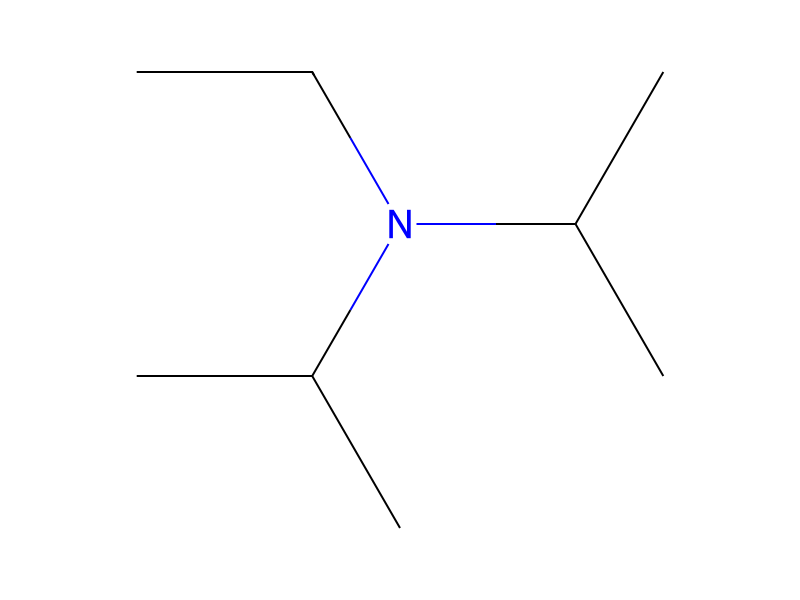
Diisopropylethylamine → Tert-butyl 3-methyl-5,8-dihydropyrido[4,3-e][1,2,4]triazine-7(6h)-carboxylate
Reaction equation

[NH2:1][C@H:2]([C:7]([C:9](OCC1C=CC=CC=1)=O)=O)[CH2:3][CH2:4]SC.I.[C:20](SC)(=[NH:22])[CH3:21].C([N:28](CC)C(C)C)(C)C.O=C1C(=O)CC[N:37]([C:42]([O:44][C:45]([CH3:48])([CH3:47])[CH3:46])=[O:43])C1>C(O)C>[CH3:21][C:20]1[N:22]=[N:28][C:7]2[CH2:9][N:37]([C:42]([O:44][C:45]([CH3:48])([CH3:47])[CH3:46])=[O:43])[CH2:4][CH2:3][C:2]=2[N:1]=1Participants
Reactant 4


Product 1

Reagents, catalysts & solvents 1
Procedure
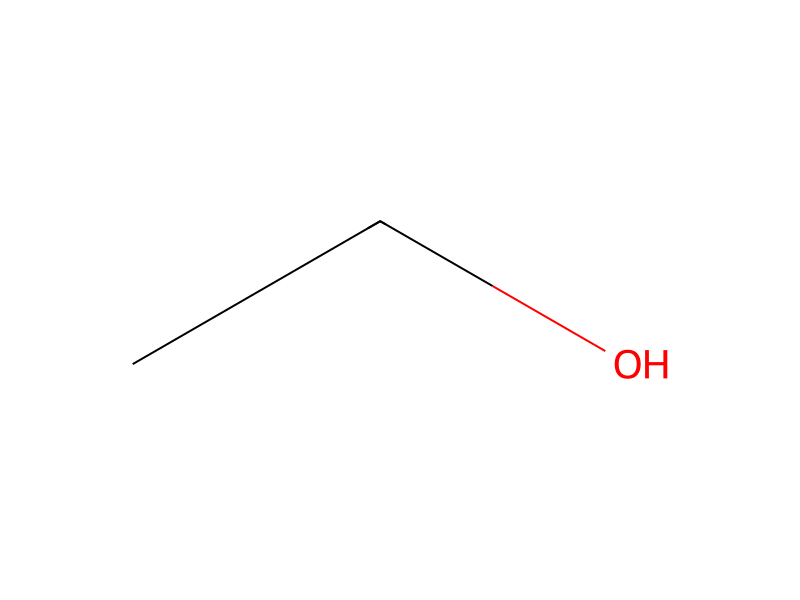
In analogy to a general literature method (Neunhoeffer and Metz, Liebigs Ann. Chem., 1476-1495 (1983)), a solution of 377 mg (1.88 mmol) of acetamidrazone hydriodide (ethanimidohydrazide hydriodide), prepared from methyl ethanimidothioate hydriodide (Singh et al., Indian J. Chem., 21B: 272-273 (1982)) according to the procedure of Zelenin et al., J. Gen. Chem. USSR, 18: 1410-1415 (1982) in 10 mL of absolute ethanol was treated with 0.36 mL (268 mg, 2.07 mmol) of N,N-diisopropylethylamine, and the solution was stirred under nitrogen at room temperature for 10 min. To this was then added dropwise a solution of 400 mg (1.88 mmol) of tert-butyl 3,4-dioxopiperidine-1-carboxylate from Step C. After being stirred initially at room temperature, the reaction mixture was heated at reflux for 4.5 h. At this time, an additional 96 mg (0.48 mmol) of the amidrazone salt was added, and stirring at reflux was continued for 3 h. The reaction mixture was concentrated in vacuo, and the residue was purified by flash chromatography (silica gel, 30-70% ethyl acetate/hexanes, then 95:5 dichloromethane/methanol) to give the title compound. The regiochemistry was assigned in analogy to Example 36, Step A, in which both possible regioisomers were isolated and assigned. 1H N (500 MHz, CDCl3) δ 4.93 (s, 2H), 3.82 (m, 2H), 3.02 (m, 2H), 2.85 (s, 3H, 1.52 (s, 9H). LC/MS: 195 (M+1-isobutene).
Workup
- stirringAfter being stirred initially at room temperature
- temperaturethe reaction mixture was heated
- temperatureat reflux for 4.5 h
- stirringstirring
- temperatureat reflux
- waitwas continued for 3 h
- concentrationThe reaction mixture was concentrated in vacuo
- customthe residue was purified by flash chromatography (silica gel, 30-70% ethyl acetate/hexanes
Sources & evidence
- ORD record
- ord-60431de0c49742c6a6b3e98f13aad8ab
- Source dataset
- uspto-grants-2008_06
- Patent number
- US07388019B2
Reaction notes
Loading…