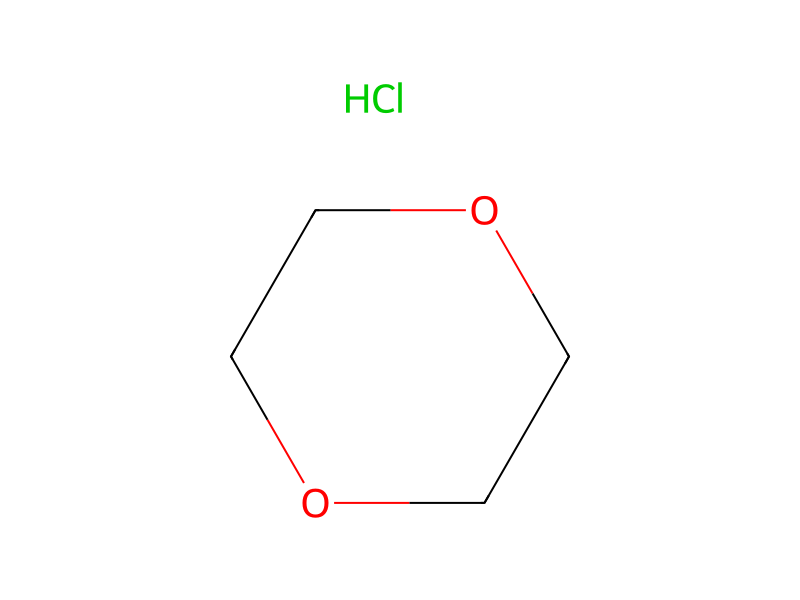
1,4-Dioxane hydrochloride → N-(3-fluoro-4-pyrrolidin-2-ylphenyl)pyrazine-2-carboxamide dihydrochloride
Reaction equation

[ClH:1].O1CCOCC1.[F:8][C:9]1[CH:14]=[C:13]([NH:15][C:16]([C:18]2[CH:23]=[N:22][CH:21]=[CH:20][N:19]=2)=[O:17])[CH:12]=[CH:11][C:10]=1[CH:24]1[CH2:28][CH2:27][CH2:26][N:25]1C(OC(C)(C)C)=O>CO>[ClH:1].[ClH:1].[F:8][C:9]1[CH:14]=[C:13]([NH:15][C:16]([C:18]2[CH:23]=[N:22][CH:21]=[CH:20][N:19]=2)=[O:17])[CH:12]=[CH:11][C:10]=1[CH:24]1[CH2:28][CH2:27][CH2:26][NH:25]1Participants
4



Procedure
50 ml of 4 N hydrochloric acid-dioxane solution was added to a methanol (50 ml) solution of 4.4 g of t-butyl 2-(2-fluoro-4-((pyrazin-2-ylcarbonyl)amino)phenyl)pyrrolidine-1-carboxylate, and the reaction liquid was stirred at room temperature for 1 hour. The solvent was evaporated away under reduced pressure to obtain the entitled compound as a yellow solid.
Workup
- customthe reaction liquid
- customThe solvent was evaporated away under reduced pressure
Sources & evidence
- ORD record
- ord-9fc5ac2acc374720aa192c73f83054b3
- Source dataset
- uspto-grants-2010_06
- Patent number
- US07728025B2
Reaction notes
Loading…