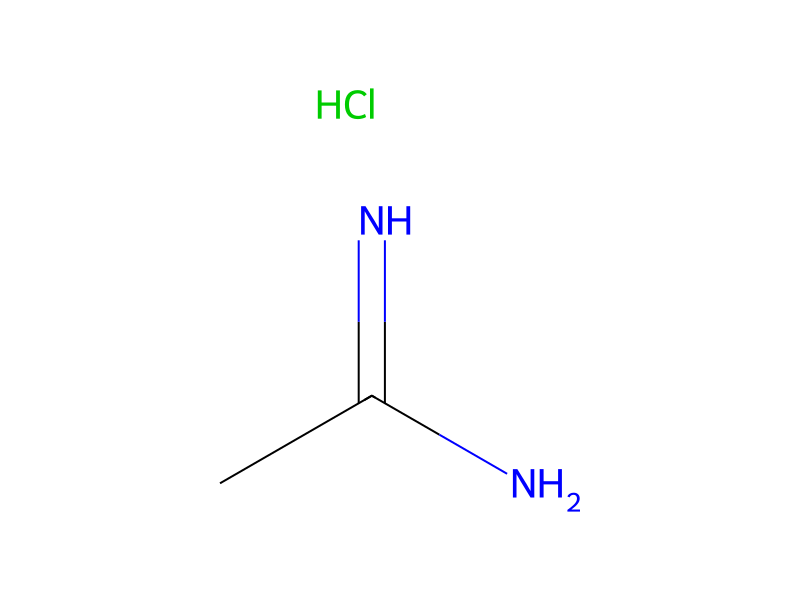
Acetamidine monohydrochloride → HCID 178433414, compound
Reaction equation

CC(C)([O-])C.[K+].Cl.[C:8]([NH2:11])(=[NH:10])[CH3:9].C[O:13][C:14]([CH:16]1[CH2:21][CH2:20][CH2:19][C:18]([CH3:28])([C:22]2[CH:27]=[CH:26][CH:25]=[CH:24][CH:23]=2)[C:17]1=O)=O>C(O)C>[CH3:9][C:8]1[N:11]=[C:14]([OH:13])[C:16]2[CH2:21][CH2:20][CH2:19][C:18]([CH3:28])([C:22]3[CH:23]=[CH:24][CH:25]=[CH:26][CH:27]=3)[C:17]=2[N:10]=1Participants
5




Procedure
A solution of potassium t-butoxide (8.4 g, 75 mmol), acetamidine hydrochloride (7.1 g, 75 mmol) and 3-methyl-2-oxo-3-phenyl-cyclohexanecarboxylic acid methyl ester (30 mmol) in 150 mL of ethanol was stirred at room temperature for 12 hours and then heated under reflux for 2 hours. The mixture was concentrated under reduced pressure, diluted with water, and washed with ether. The aqueous layer was neutralized with HCl and filtered to afford 4.0 g of 2,8-dimethyl-8-phenyl-5,6,7,8-tetrahydro-quinazolin-4-ol as a white solid.
Workup
- temperatureheated
- temperatureunder reflux for 2 hours
- concentrationThe mixture was concentrated under reduced pressure
- additiondiluted with water
- washwashed with ether
- filtrationfiltered
Sources & evidence
- ORD record
- ord-3320c159821641c49fc499b71acd4f24
- Source dataset
- uspto-grants-2007_05
- Patent number
- US07223767B2
Reaction notes
Loading…