Sodium Chloride → HCID 535945, compound
Reaction equation

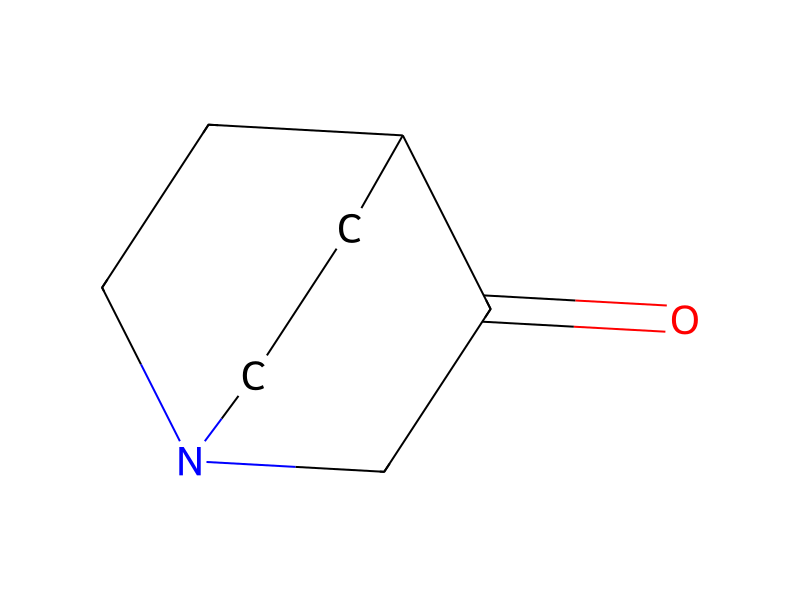
[N:1]12[CH2:8][CH2:7][CH:4]([CH2:5][CH2:6]1)[C:3](=O)[CH2:2]2.[OH-].[K+].CCOP(OCC)([CH2:17][C:18]#[N:19])=O.[Na+].[Cl-]>O>[C:18]([CH:17]=[C:3]1[CH:4]2[CH2:7][CH2:8][N:1]([CH2:6][CH2:5]2)[CH2:2]1)#[N:19]Participants
6
Reactant 4



Product 1

Reagents, catalysts & solvents 1

Procedure
To a stirred solution of 3-quinuclidinone (50 g; 0.309 mol) in water (250 ml) was added potassium hydroxide (17.35 g; 0.309 mol). After 15 minutes, diethyl cyanomethyl phosphonate (109.6 g; 0.619 mol) was added with a further 125 ml water. A solution of potassium hydroxide (52.07 g; 0.928 mol) in water (250 ml) was added dropwise over 30 minutes. The reaction was left overnight, saturated with NaCl then extracted into ethyl acetate (6×200 ml). The organic extracts were combined, dried over anhydrous K2CO3 and concentrated in vacuo to give 3-cyanomethylidene quinuclidine (44 g; 96%, (96% pure-gc)) as a 2:1 mixture of Z:E isomers.
Workup
- extractionthen extracted into ethyl acetate (6×200 ml)
- dry with materialdried over anhydrous K2CO3
- concentrationconcentrated in vacuo
Sources & evidence
- ORD record
- ord-936de1e0c5f0477b9d3a1936375dbf11
- Source dataset
- uspto-grants-2003_07
- Patent number
- US06596869B2
Reaction notes
Loading…