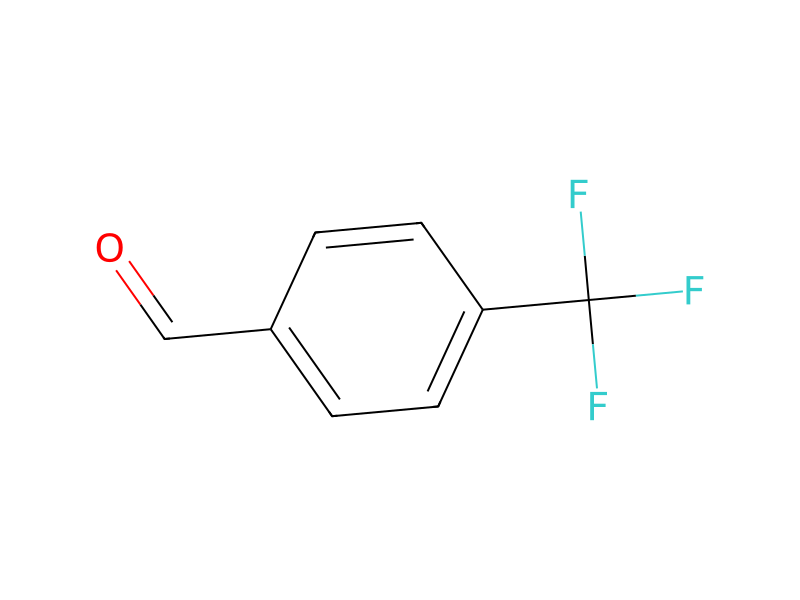
4-(Trifluoromethyl)benzoyl chloride → 4-(Trifluoromethyl)benzaldehyde
Reaction equation

FC(F)(F)C1C=CC=C(C(F)(F)F)C=1.[F:15][C:16]([F:27])([F:26])[C:17]1[CH:25]=[CH:24][C:20]([C:21](Cl)=[O:22])=[CH:19][CH:18]=1.[H][H]>O>[F:15][C:16]([F:26])([F:27])[C:17]1[CH:25]=[CH:24][C:20]([CH:21]=[O:22])=[CH:19][CH:18]=1Participants
5
Reactant 3



Product 1
Reagents, catalysts & solvents 1

Conditions
- Temperature
- 105 °C
Procedure
1 g of 5% palladium on barium sulfate (recovered from Example 1) and 100 g of 4-trifluoromethylbenzoyl chloride were placed in a reaction vessel at room temperature with exclusion of water. A gentle stream of hydrogen gas was then introduced at atmospheric pressure. The mixture was subsequently heated to 100-110° C. and hydrogen gas was introduced continuously at atmospheric pressure. After liberation of acidic offgases had ceased (6.5 hours), the mixture was cooled to room temperature, the catalyst was removed by filtration, and the filtrate was distilled at 33 mbar. At a boiling point of 82-86° C., 4-trifluoromethylbenzaldehyde was obtained in a yield of 45.9 g. This corresponds to a yield of 54% of theory.
Workup
- custom(6.5 hours)
- temperaturethe mixture was cooled to room temperature
- customthe catalyst was removed by filtration
- distillationthe filtrate was distilled at 33 mbar
Sources & evidence
- ORD record
- ord-b9cc10ac70894f97b1d7e353be8af0fa
- Source dataset
- uspto-grants-2003_07
- Patent number
- US06596906B2
Reaction notes
Loading…