Ethyl benzoylacetate → 6-Bromo-2-phenylquinolin-4(1H)-one
Reaction equation

[Br:1][C:2]1[CH:8]=[CH:7][C:5]([NH2:6])=[CH:4][CH:3]=1.[C:9]([CH2:17][C:18](OCC)=[O:19])(=O)[C:10]1[CH:15]=[CH:14][CH:13]=[CH:12][CH:11]=1>>[Br:1][C:2]1[CH:8]=[C:7]2[C:5](=[CH:4][CH:3]=1)[NH:6][C:9]([C:10]1[CH:15]=[CH:14][CH:13]=[CH:12][CH:11]=1)=[CH:17][C:18]2=[O:19]Participants

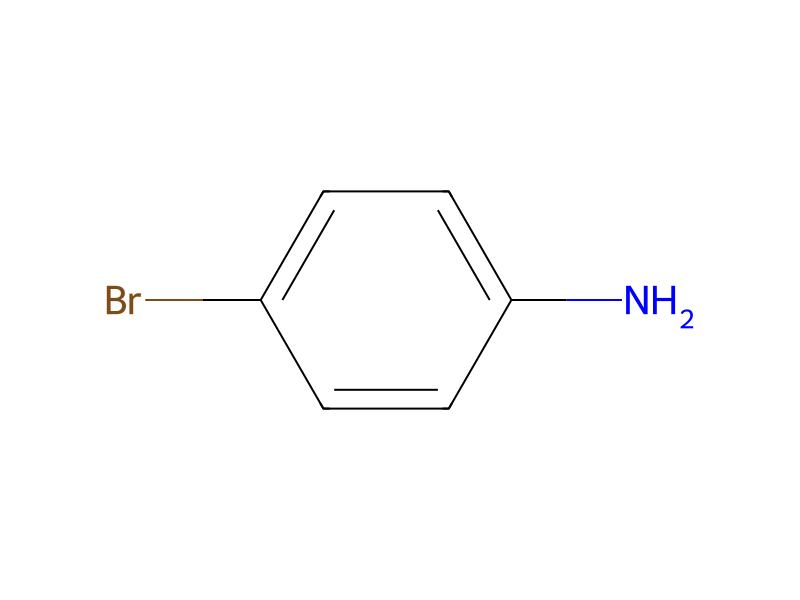

Conditions
- Temperature
- 150 °C
Procedure
A mixture of 4-bromoaniline (7.0 g, 40.7 mmol), ethyl benzoylacetate (14.09 mL, 81.4 mmol), and polyphosphoric acid (15.95 g, 162.7 mmol) was heated without solvent to 150° C. for 3 h. After 3 h, the reaction was cooled to RT, and the mixture was quenched with 4 N HCl (200 mL), which caused an orange cake to form. This solid was filtered, and to this was added 2N NaOH (200 mL). The majority of the solid did not dissolve, and was filtered off. The solid was washed with water (200 mL) and a mixture of 1:1 acetone/DCM (200 mL), and stored under vacuum overnight to give 6.52 g (53% yield) of ˜95% (by LC-MS) pure 6-bromo-2-phenylquinolin-4(1H)-one. Further purification can be accomplished by recrystallization with n-butoxyethanol to yield analytically pure material. 1H NMR (400 MHz, DMSO-d6) ppm: 11.87 (br s, 1H), 8.18 (d, J=2.4 Hz, 1H), 7.82 (m, 3H), 7.73 (d, J=8.8 Hz, 1H), 7.60 (m, 3H), 6.39 (d, J=1.6 Hz, 1H). LRMS (CI, [M+H]) Calc'd=300.1. found=300.1.
Workup
- temperaturethe reaction was cooled to RT
- customthe mixture was quenched with 4 N HCl (200 mL), which
- customto form
- filtrationThis solid was filtered
- additionto this was added 2N NaOH (200 mL)
- dissolutionThe majority of the solid did not dissolve
- filtrationwas filtered off
- washThe solid was washed with water (200 mL)
- additiona mixture of 1:1 acetone/DCM (200 mL)
- customstored under vacuum overnight
Sources & evidence
- ORD record
- ord-7c532a8dd9fe48f3ac35eefa36137946
- Source dataset
- uspto-grants-2011_02
- Patent number
- US07879797B2
Reaction notes
Loading…