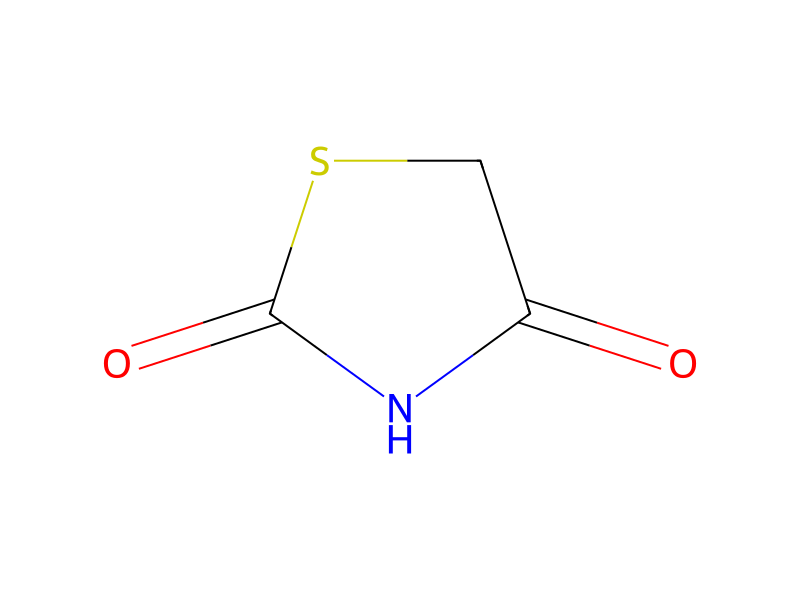
Thiazolidinedione → 2-[3-[(2,4-Dioxo-1,3-thiazolidin-5-ylidene)methyl]phenoxy]acetic acid
Reaction equation

[S:1]1[CH2:5][C:4](=[O:6])[NH:3][C:2]1=[O:7].[CH:8]([C:10]1[CH:11]=[C:12]([CH:18]=[CH:19][CH:20]=1)[O:13][CH2:14][C:15]([OH:17])=[O:16])=O.C([O-])(=O)C.[Na+]>C(O)(=O)C>[O:7]=[C:2]1[NH:3][C:4](=[O:6])[C:5](=[CH:8][C:10]2[CH:11]=[C:12]([CH:18]=[CH:19][CH:20]=2)[O:13][CH2:14][C:15]([OH:17])=[O:16])[S:1]1Participants
5



Procedure
Thiazolidine-2,4-dione (3.9 g, 33 mmol), 3-formylphenoxyacetic acid (6.0 g, 33 mmol), anhydrous sodium acetate (13.6 g, 165 mmol) and acetic acid (100 mL) was refluxed for 16 h. After cooling, the mixture was filtered and washed with acetic acid and water. Drying in vacuo afforded 5.13 g (56%) of [3-(2,4-dioxothiazolidin-5-ylidenemethyl)phenoxy]acetic acid as a solid.
Workup
- temperatureAfter cooling
- filtrationthe mixture was filtered
- washwashed with acetic acid and water
- customDrying in vacuo
Sources & evidence
- ORD record
- ord-11134981278d496c8216f64a9689da0f
- Source dataset
- uspto-grants-2011_02
- Patent number
- US07879893B2
Reaction notes
Loading…