Sodium Carbonate → ethyl 3-bromo-1-(1-ethoxyethyl)-1H-thieno[2,3-c]pyrazole-5-carboxylate
Reaction equation

[Br:1][C:2]1[C:6]([CH:7]=O)=[C:5](Br)[N:4]([CH:10]([O:12][CH2:13][CH3:14])[CH3:11])[N:3]=1.C(=O)([O-])[O-].[Na+].[Na+].[SH:21][CH2:22][C:23]([O:25][CH2:26][CH3:27])=[O:24]>C(O)C>[Br:1][C:2]1[C:6]2[CH:7]=[C:22]([C:23]([O:25][CH2:26][CH3:27])=[O:24])[S:21][C:5]=2[N:4]([CH:10]([O:12][CH2:13][CH3:14])[CH3:11])[N:3]=1Participants

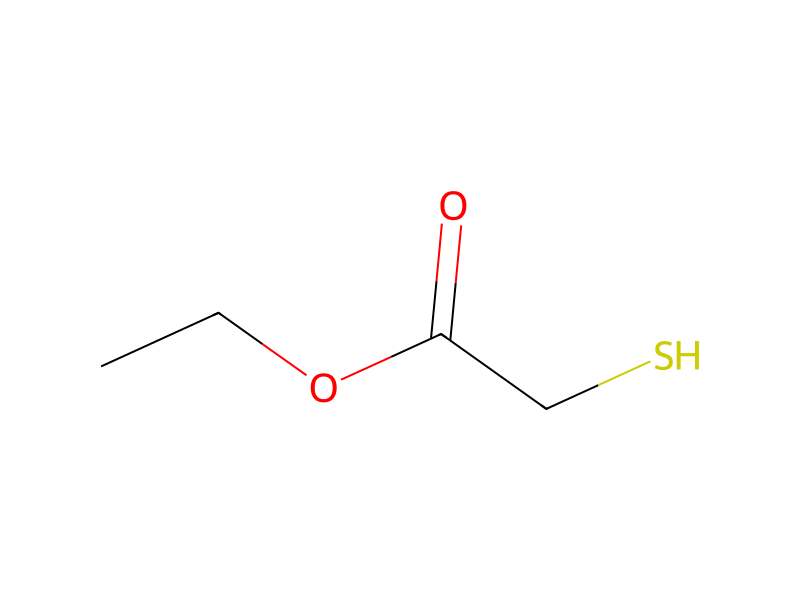



Procedure
1.19 g (3.81 mmol) of 3,5-dibromo-1-(1-ethoxyethyl)-1H-pyrazole-4-carboxaldehyde are introduced with stirring into 50 cm3 of ethanol under an argon atmosphere, at a temperature in the region of 20° C., followed by addition of 0.4 g (3.81 mmol) of sodium carbonate and 0.42 cm3 (3.81 mmol) of ethyl 2-mercaptoacetate. The reaction mixture is then refluxed for 2 hours, and concentrated to dryness under reduced pressure (2.7 kPa). The residue is taken up in 60 cm3 of water and 60 cm3 of dichloromethane, and the phases are separated by settling. The organic phase is dried over magnesium sulfate and then concentrated to dryness under reduced pressure (2.7 kPa). 1.17 g of ethyl 3-bromo-1-(1-ethoxyethyl)-1H-thieno[2,3-c]pyrazole-5-carboxylate are thus obtained in the form of a clear yellow oil that crystallizes to give cream-colored crystals melting at 69° C.
Workup
- temperatureThe reaction mixture is then refluxed for 2 hours
- concentrationconcentrated to dryness under reduced pressure (2.7 kPa)
- custom60 cm3 of dichloromethane, and the phases are separated
- dry with materialThe organic phase is dried over magnesium sulfate
- concentrationconcentrated to dryness under reduced pressure (2.7 kPa)
Sources & evidence
- ORD record
- ord-8c5748c96f0a49ae8a225f4cc8a92926
- Source dataset
- uspto-grants-2011_02
- Patent number
- US07884123B2
Reaction notes
Loading…