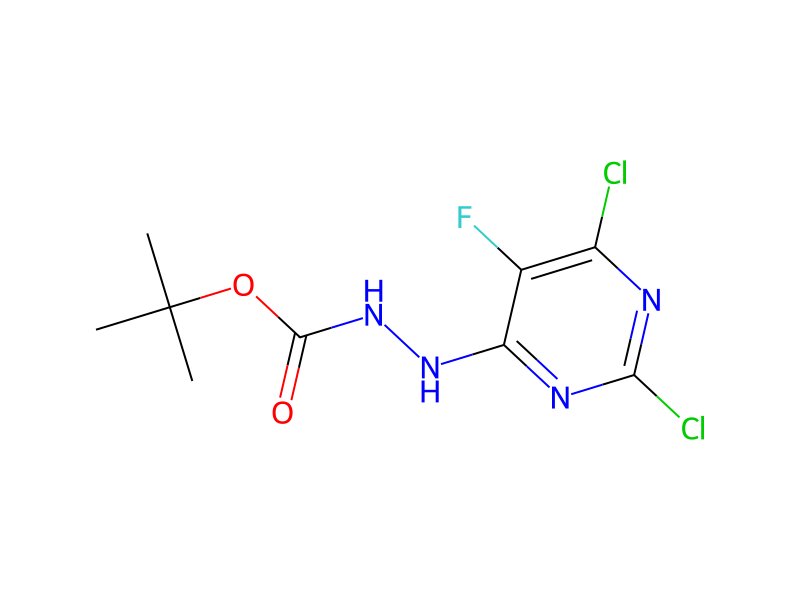
Ethyl Acetate → 1,1-Dimethylethyl 2-(2,6-dichloro-5-fluoro-4-pyrimidinyl)hydrazinecarboxylate
Reaction equation

[Cl:1][C:2]1[N:7]=[C:6]([Cl:8])[C:5]([F:9])=[C:4](Cl)[N:3]=1.[C:11]([O:15][C:16]([CH3:19])([CH3:18])[CH3:17])(=[O:14])[NH:12][NH2:13].C(N(C(C)C)CC)(C)C.CCOC(C)=O>C1COCC1>[Cl:1][C:2]1[N:3]=[C:4]([NH:13][NH:12][C:11]([O:15][C:16]([CH3:19])([CH3:18])[CH3:17])=[O:14])[C:5]([F:9])=[C:6]([Cl:8])[N:7]=1Participants
6
Reactant 4




Product 1
Reagents, catalysts & solvents 1

Procedure
2,4,6-Trichloro-5-fluoropyrimidine (20.92 g, 104.1 mmol) was dissolved in THF (300 mL) at room temperature and stirred. To this stirring solution was added t-butyl carbazate (13.74 g, 104.1 mmol), followed by diisopropylethylamine (19.0 mL, 109.3 mmol). The reaction mixture turned light yellow, and after several minutes a precipitate formed. The reaction appeared complete after 1.5 h, as monitored by TLC (10% EtOAc/Hex). The reaction mixture was concentrated in vacuo to remove most of the THF, and the residue was dissolved in CH2Cl2 (˜400 mL). The solution was washed with ˜400 mL of sat. aq. NH4Cl. The organics were dried and concentrated to give a pale yellow solid (31.37 g). LCMS: (M+H+2Na-Boc)+: 241.
Workup
- customafter several minutes a precipitate formed
- concentrationThe reaction mixture was concentrated in vacuo
- customto remove most of the THF
- dissolutionthe residue was dissolved in CH2Cl2 (˜400 mL)
- washThe solution was washed with ˜400 mL of sat. aq. NH4Cl
- customThe organics were dried
- concentrationconcentrated
Sources & evidence
- ORD record
- ord-543f4d8f1678433ebc25c457074b7ada
- Source dataset
- uspto-grants-2011_02
- Patent number
- US07893056B2
Reaction notes
Loading…