Water → HCID 10868329, compound
Reaction equation

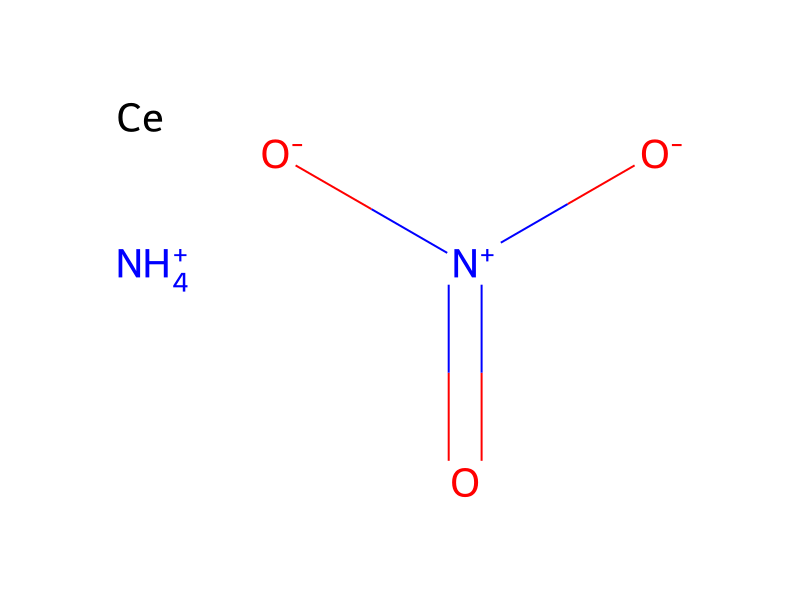
[Br:1][C:2]1[C:11]2[C:6](=[C:7]([O:14]C)[CH:8]=[CH:9][C:10]=2[O:12]C)[N:5]=[CH:4][CH:3]=1.O.[N+]([O-])([O-])=O.[NH4+].[Ce]>CC#N>[Br:1][C:2]1[C:11]2[C:10](=[O:12])[CH:9]=[CH:8][C:7](=[O:14])[C:6]=2[N:5]=[CH:4][CH:3]=1Participants
5
Reactant 3


Product 1

Reagents, catalysts & solvents 1

Procedure
100 mg (0.373 mmol) of 4-bromo-5,8-dimethoxyquinoline are dissolved in 8 mL of CH3CN and 4 mL of water at room temperature. 0.6 g (1.11 mmol) of cerium ammonium nitrate (CAN) is added and the mixture is stirred for 30 min. After evaporating off the CH3CN on a rotary evaporator, 100 mL of water are added and the medium is extracted with CHCl3 (3 times 100 mL). After drying the organic phases over MgSO4 and evaporating off the solvent on a rotary evaporator, 83 mg of quinone are obtained in the form of a pinkish powder.
Workup
- customat room temperature
- customAfter evaporating off the CH3CN
- customon a rotary evaporator, 100 mL of water
- additionare added
- extractionthe medium is extracted with CHCl3 (3 times 100 mL)
- dry with materialAfter drying the organic phases over MgSO4
- customevaporating off the solvent
- customon a rotary evaporator, 83 mg of quinone
- customare obtained in the form of a pinkish powder
Sources & evidence
- ORD record
- ord-457761b3ce1648c29ca7777c14f23a20
- Source dataset
- uspto-grants-2003_06
- Patent number
- US06583150B1
Reaction notes
Loading…