Phosgene → Carbonochloridic acid, 2,4,5-trichlorophenyl ester
Reaction equation

[C:1](Cl)([Cl:3])=[O:2].[Cl:5][C:6]1[CH:11]=[C:10]([Cl:12])[C:9]([Cl:13])=[CH:8][C:7]=1[OH:14].N1C2C(=CC=CC=2)C=CC=1>ClCCl>[Cl:3][C:1]([O:14][C:7]1[CH:8]=[C:9]([Cl:13])[C:10]([Cl:12])=[CH:11][C:6]=1[Cl:5])=[O:2]Participants
Reactant 3


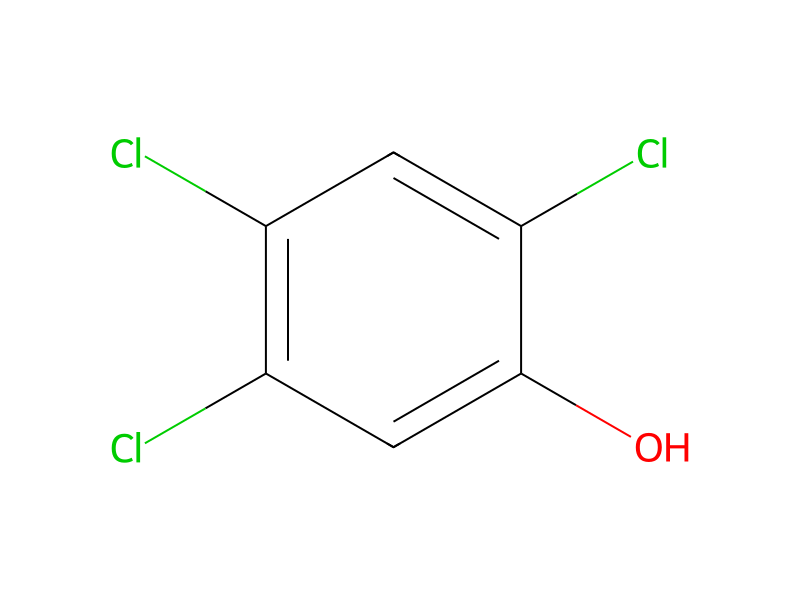
Product 1

Reagents, catalysts & solvents 1

Conditions
- Temperature
- 0 °C
Procedure
About 7 g of phosgene are passed into a solution of 10.0 g of 2,4,5-trichlorophenol in 50 ml of dichloromethane at 0° C., and the mixture is stirred at 0° C. for 15 min. 7.2 ml of quinoline in 20 ml of dichloromethane are added dropwise over the course of 30 min, and the orange-colored suspension is then stirred in an ice bath for 1 h. Subsequently nitrogen is passed through the suspension for 1 h in order to blow out excess phosgene (absorber tower). The mixture is subsequently filtered, and the filtrate is washed twice with water, dried, again filtered and evaporated to dryness in vacuo. The 4.45 g of oily brownish residue are relatively pure 2,4,5-trichlorophenyl chloroformate, which crystallizes in the refrigerator and can be employed without further purification.
Workup
- stirringthe orange-colored suspension is then stirred in an ice bath for 1 h
- waitSubsequently nitrogen is passed through the suspension for 1 h in order
- filtrationThe mixture is subsequently filtered
- washthe filtrate is washed twice with water
- customdried
- filtrationagain filtered
- customevaporated to dryness in vacuo
- customcrystallizes in the refrigerator
- customcan be employed without further purification
Sources & evidence
- ORD record
- ord-dae3b58bc3fc481baebdcff7e34f3ebc
- Source dataset
- uspto-grants-1997_09
- Patent number
- US05663141
Reaction notes
Loading…