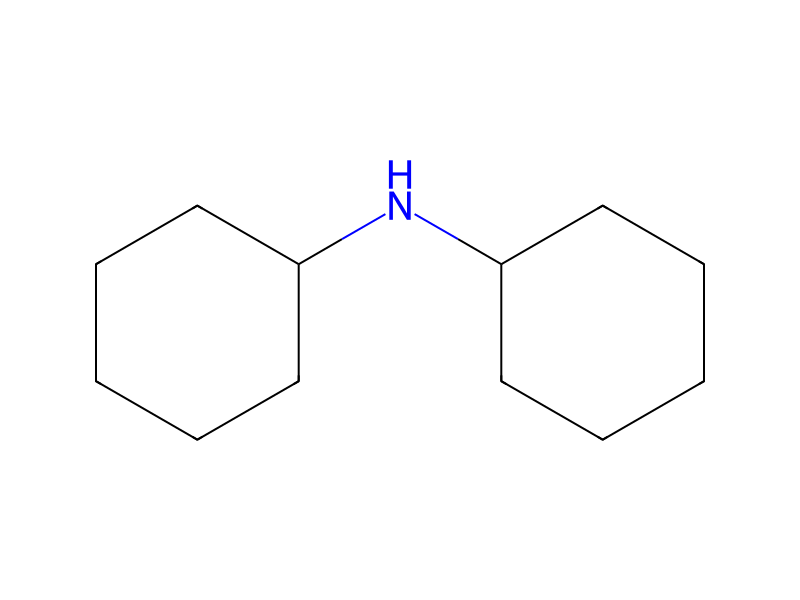
Dicyclohexylamine → Dicyclohexylammonium chloride
Reaction equation

N1CCC(C2N=CNC=2)CC1.[CH:12]1([NH:18][CH:19]2[CH2:24][CH2:23][CH2:22][CH2:21][CH2:20]2)[CH2:17][CH2:16][CH2:15][CH2:14][CH2:13]1.C1(CCCCC([Cl:37])=O)CCCCC1>C(#N)C.ClCCl>[Cl-:37].[CH:19]1([NH2+:18][CH:12]2[CH2:13][CH2:14][CH2:15][CH2:16][CH2:17]2)[CH2:20][CH2:21][CH2:22][CH2:23][CH2:24]1Participants
6




Conditions
- Temperature
- 60 °C
Procedure
To a mixture of 755 mg (5.00 mmol) 4-(4-piperidyl) 1-H-imidazole and 942 mg (5.20 mmol) of dicyclohexylamine in 10 ml anhydrous acetonitrile at 25° C. was slowly added 1.06 g (5.20 mmol) cyclohexanevaleroyl chloride in 2 ml dichloromethane. The acid chloride was added over a period of ten minutes and then heated at 60° C. for 1.5 hr. After cooling to ambient temperature, the solid obtained (dicyclohexylammonium chloride) was filtered off and the filtrate was concentrated in vacuo to remove acetonitrile. The resulting crude oil was crystallized with methanol: anhydrous diethyl ether to give 1.085 mg of analytically pure product as a yellow powder.
Workup
- temperatureAfter cooling to ambient temperature
Sources & evidence
- ORD record
- ord-779bdc88d81f41a193aeb733c48acf20
- Source dataset
- uspto-grants-1997_09
- Patent number
- US05663350
Reaction notes
Loading…