Phenylpyruvic acid → HCID 12918242, compound
Reaction equation

[C:1]1([CH2:7][C:8](=[O:12])[C:9]([OH:11])=[O:10])[CH:6]=[CH:5][CH:4]=[CH:3][CH:2]=1.[Br:13]Br>C(O)(=O)C>[Br:13][CH:7]([C:1]1[CH:6]=[CH:5][CH:4]=[CH:3][CH:2]=1)[C:8](=[O:12])[C:9]([OH:11])=[O:10]Participants
4
Reactant 2
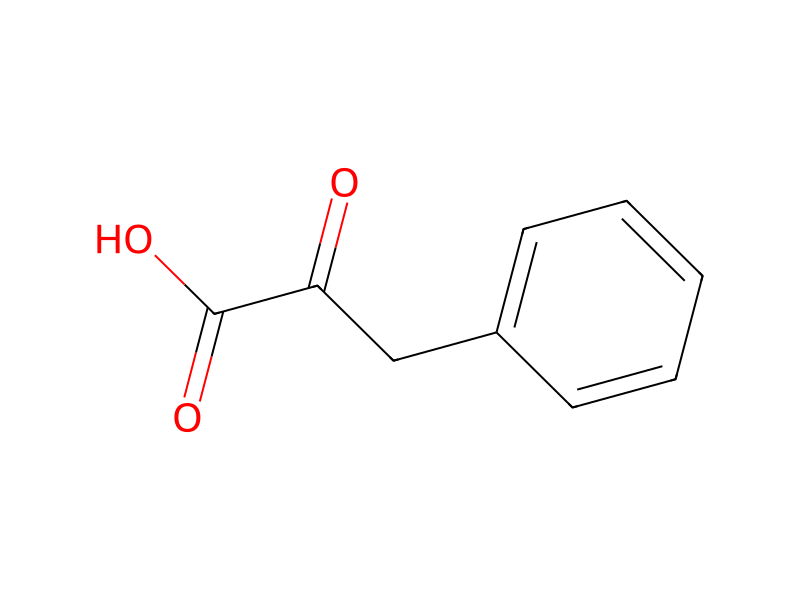

Product 1

Reagents, catalysts & solvents 1

Procedure
12.31 g of phenyl-pyruvic acid and 50 ml of acetic acid were mixed together and then a solution of 12.34 g of bromine in 4 ml of acetic acid was added drop by drop over 1 hour. After the introduction was finished, stirring was continued for 15 minutes, followed by concentration to dryness under reduced pressure. The residue was taken up in 40 ml of dichloroethane and concentrated to dryness under reduced pressure, 30 ml of dichloroethane were added, and crystallization was allowed for 2 hours at 20° C. to obtain 12.6 g of 3-bromo-3-phenyl-pyruvic acid melting at 110° C.
Workup
- concentrationfollowed by concentration to dryness under reduced pressure
- concentrationconcentrated to dryness under reduced pressure, 30 ml of dichloroethane
- additionwere added
- customcrystallization
- waitwas allowed for 2 hours at 20° C.
Sources & evidence
- ORD record
- ord-10c4840246bd455bb6b8b9cb1ed68cc5
- Source dataset
- uspto-grants-1997_09
- Patent number
- US05663164
Reaction notes
Loading…