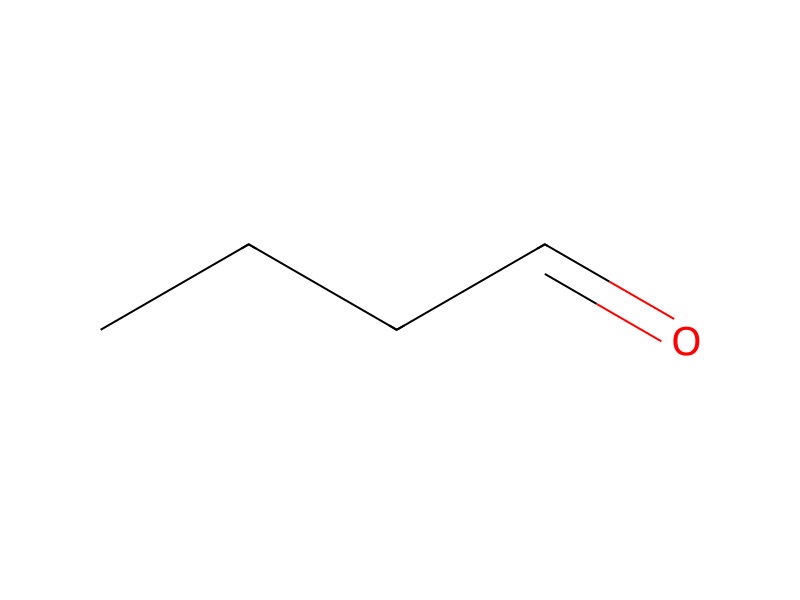
Butanal → 2-Ethylhexanol
Reaction equation

[CH2:1]([CH:3]([CH:6](O)[CH2:7][CH2:8][CH3:9])[CH2:4][OH:5])[CH3:2].C(=O)CCC>>[CH2:1]([CH:3]([CH2:6][CH2:7][CH2:8][CH3:9])[CH2:4][OH:5])[CH3:2].[CH2:1]([C:3](=[CH:6][CH2:7][CH2:8][CH3:9])[CH:4]=[O:5])[CH3:2]Participants


Procedure
According to the present invention, 2-ethyl-1,3-hexane diol is thus prepared from n-butyraldehyde. 0.5-10% by weight, preferably 5-15% by weight, of a neutral phase-transfer catalyst is added to n-butyraldehyde, one such catalyst being, for example, polyethylene glycol (PEG 400), whereafter the mixture is cooled to 0°-20° C. The reaction may also be started from room temperature, but preferably so that the mixture is first cooled. Most preferably the reaction mixture is cooled to a temperature of 5°-15° C., and thereafter an aqueous solution of an alkali metal hydroxide or alkali earth metal hydroxide catalyst is added to the mixture drop by drop at such a rate that the reaction clearly starts, i.e. the temperature of the mixture clearly rises from its original value. The alkali metal hydroxide or alkali earth metal hydroxide is used in a proportion of 0.01-5% by weight, preferably 0.1-1% by weight, to n-butyraldehyde. The adding of the aqueous solution of the catalyst is discontinued when the temperature of the mixture has risen to the range 25°-45° C., preferably, however, to the range 30°-40° C. After the discontinuation of the adding of the catalyst, the mixture is further stirred for 0-5 h, preferably 0.2-3 h, whereafter the organic phase and the aqueous phase are separated from each other. Before the separation of the phases the reaction mixture may be neutralized with a mineral acid or an organic acid. The organic phase is recovered, and it is hydrogenated by catalytic hydrogenation at a temperature of 30°-200° C. and a pressure of 5-100 bar, preferably at a temperature of 60°-140° C. and a pressure of 10-60 bar. The hydrogenation may be carried out by using, for example, a Raney nickel catalyst. After the hydrogenation the product is vacuum distilled. The boiling point of 2-ethyl-1,3-hexane diol is 100° C./6 mbar, and a yield of up to more than 55% is obtained. When the process according to the invention is used, the worst byproduct, 2-ethyl hexanol via 2-ethyl hexenal, is formed at maximum at a rate of 2.6%. The rest of the reaction mixture is unreacted n-butyraldehyde which has become reduced to 1-butanol.
Workup
- temperatureis cooled to 0°-20° C
- customThe reaction
- custommay also be started from room temperature
- temperaturepreferably so that the mixture is first cooled
- temperatureMost preferably the reaction mixture is cooled to a temperature of 5°-15° C.
- customthat the reaction
- additionThe adding of the aqueous solution of the catalyst
- customhas risen to the range 25°-45° C.
- customto the range 30°-40° C
- additionAfter the discontinuation of the adding of the catalyst
- customthe aqueous phase are separated from each other
- customBefore the separation of the phases the reaction mixture
- customThe organic phase is recovered
- customis hydrogenated by catalytic hydrogenation at a temperature of 30°-200° C.
- custompreferably at a temperature of 60°-140° C.
- distillationdistilled
- customis 100° C.
- customa yield of up to more than 55% is obtained
Sources & evidence
- ORD record
- ord-0cfd7b986b624ab29a4e7a58d06f3558
- Source dataset
- uspto-grants-1997_09
- Patent number
- US05663452
Reaction notes
Loading…