Lauric Acid → Lauric Acid
Reaction equation

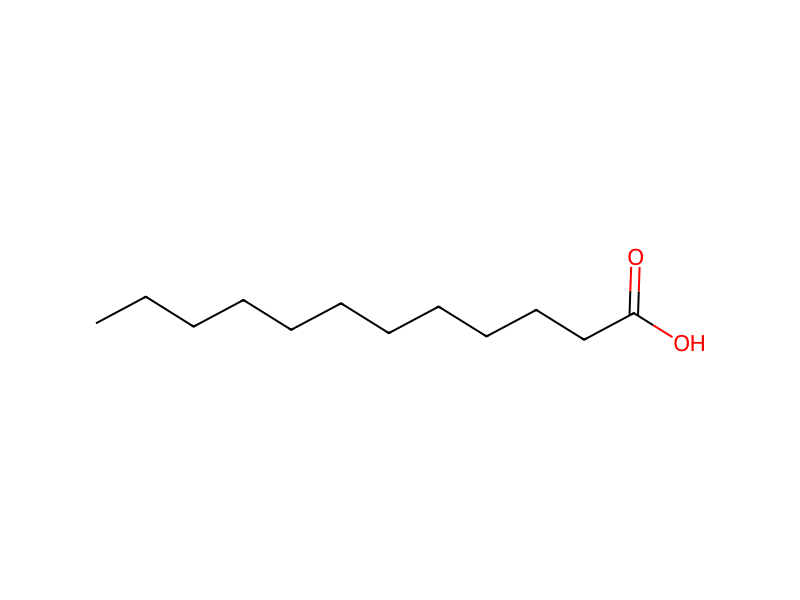
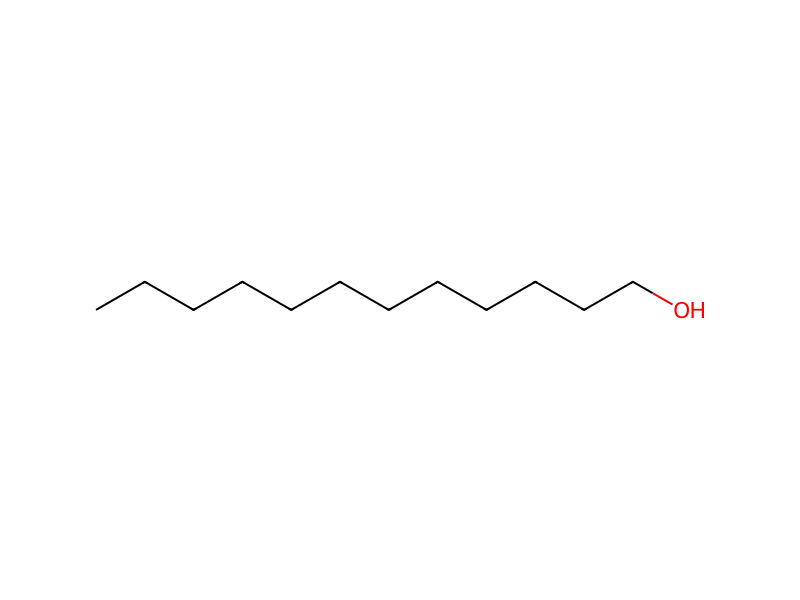
[C:1]([OH:14])(=[O:13])[CH2:2][CH2:3][CH2:4][CH2:5][CH2:6][CH2:7][CH2:8][CH2:9][CH2:10][CH2:11][CH3:12].[H][H]>>[C:1]([OH:14])(=[O:13])[CH2:2][CH2:3][CH2:4][CH2:5][CH2:6][CH2:7][CH2:8][CH2:9][CH2:10][CH2:11][CH3:12].[CH2:1]([OH:13])[CH2:2][CH2:3][CH2:4][CH2:5][CH2:6][CH2:7][CH2:8][CH2:9][CH2:10][CH2:11][CH3:12]Participants

Conditions
- Temperature
- 60 °C
Procedure
700 g of catalyst produced in accordance with formulation 3. above were introduced into a continuous recycle-gas pilot plant having a reactor volume of 1 liter and activated as described above. Thereafter, 100 ml/h of pure lauric acid, which had been preheated to 240° C., was passed over the catalyst in the presence of hydrogen recirculated at a rate of 16 l/h under a pressure of 250 bars (corresponding to 4 m3 /h in the absence of pressure; equal to a 178.5-fold molar excess) at 270° C. Most of the lauric acid evaporated on the catalyst. The hydrogen leaving the reactor was cooled to about 60° C., the hydrogenation product separating and being relieved of pressure. 1 kg of lauric acid produced 920 g of pure lauryl alcohol which accumulated in colorless form with a saponification number of 0.5, an acid number of 0.06, a paraffin content of 0.96% and a low water content. After drying, its hydroxyl number was 299. The aldehyde content of 215 ppm of CO was very low. After about 140 hours' operation under the described conditions, the saponification number rose to 5.2. Because of this, the reactor entry temperature (reaction temperature) was increased to 300° C., as a result of which the saponification number fell below 1.
Workup
- additionabove were introduced into a continuous recycle-gas pilot plant
- customhad been preheated to 240° C.
- customat 270° C
- customMost of the lauric acid evaporated on the catalyst
- customthe hydrogenation product separating
Sources & evidence
- ORD record
- ord-5d3efe4c7ada4a55ad8b82cf06ce023b
- Source dataset
- uspto-grants-1989_02
- Patent number
- US04804790
Reaction notes
Loading…